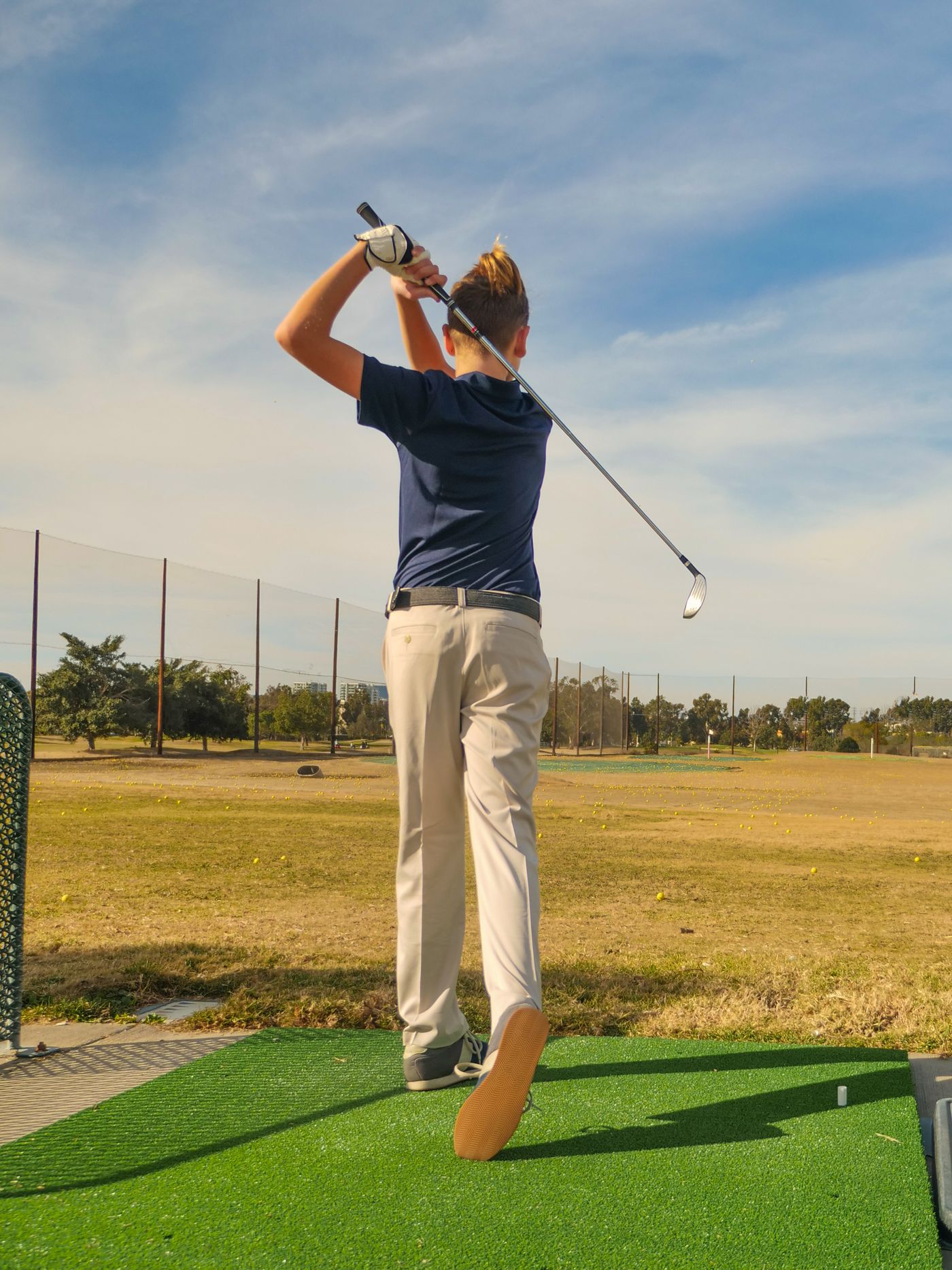
Why a centered turn matters
During the backswing a golfer can rotate yet also slide excessively sideways, complicating the return to the ball. Coach Jake Thurm described a no-club mirror rehearsal on April 26, 2026, in GOLF.com. The purpose is to spot unwanted lateral sway—not to immobilize the head, spine or natural weight transfer.
Four steps in front of a mirror
1. Establish a reference. Face a full-length mirror in a comfortable golf stance. Visualize a vertical line through the center of the shirt buttons and the belt buckle. Thurm demonstrates a dry-erase line on the mirror; if marking the glass, use only a suitable erasable product. An imaginary reference also works.
2. Prepare the position. For a right-hander the lead side is left; for a left-hander it is right. Gently tilt the upper body toward the target and touch the lead knee with the lead hand. Thurm's setup allows a small pelvic shift away from the target. Do not force a sharp hip bump.
3. Make the turn. Fold the arms over the chest and rotate slowly as in a backswing. Watch whether the center of the torso travels excessively away from the starting reference. Extend the arms to imagine the top-of-backswing position, without forcing extra range.
4. Reset and compare. Return comfortably to the original position. If the entire torso shifts far sideways, try a smaller turn first. A few slow repetitions are an editorial practice suggestion, not a measured training prescription by Thurm.
Centered is not motionless
In a Titleist coaching video, John Kostis cautions against keeping the head completely frozen: this can restrict thoracic rotation. His distinction is stay centered, not stay still. Natural head and body movement can still occur. Use the mirror as feedback rather than a rigid physical constraint.
Limits of the check
A mirror may expose excessive lateral movement, but it cannot by itself prove better impact, greater clubhead speed or a lower handicap. Compare the rehearsal with real shots and consult a qualified coach where appropriate. Stop if the motion is painful.
Original coaching sources: Jake Thurm, GOLF.com (April 26, 2026); John Kostis, Titleist (March 22, 2021).