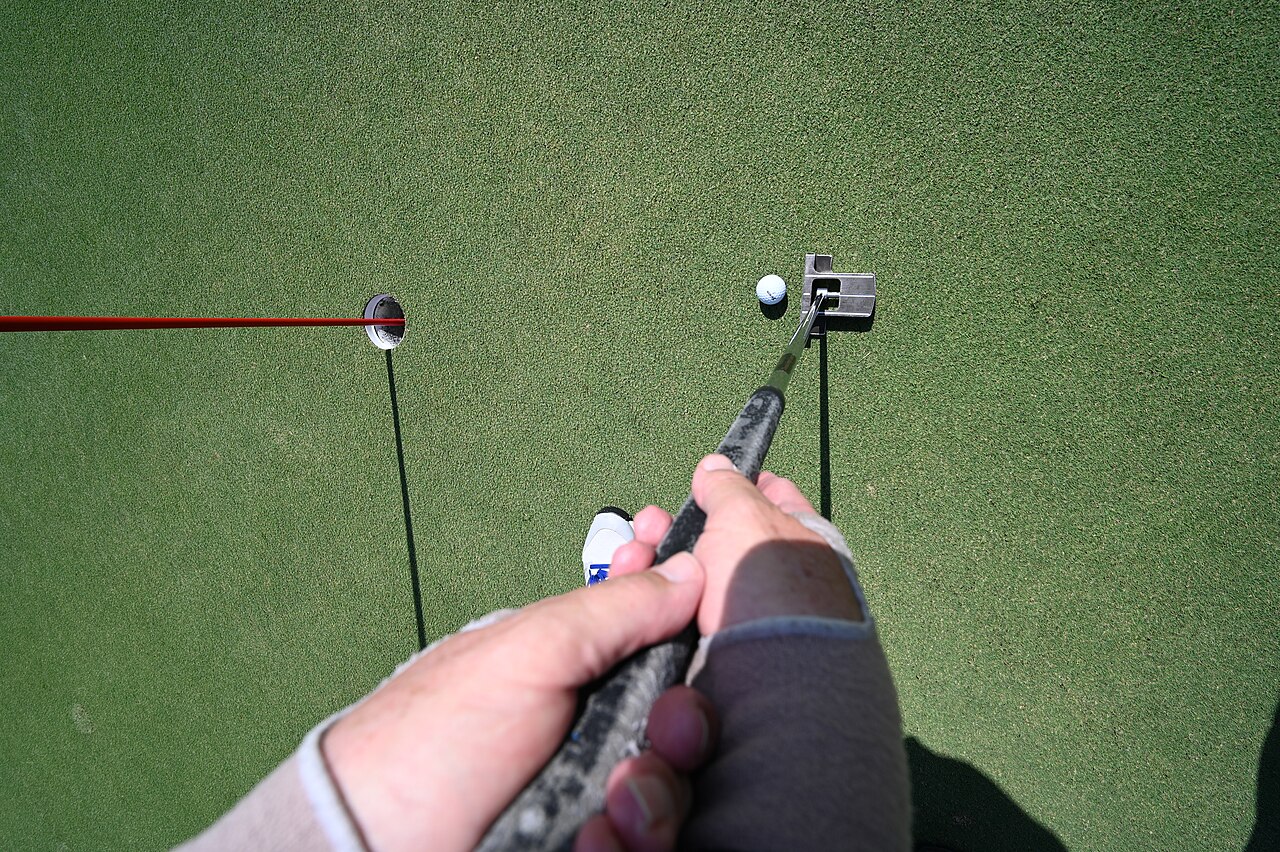
A 12-foot putt is more than a single perfect line
Putting is not determined by aim alone. The direction of the putter face at impact, the movement of the clubhead, its lowest point and the ball's early motion all matter. A research paper included in the October 2026 issue of the International Journal of Sports Science & Coaching examined combinations of these measures rather than treating each one as an isolated secret. The paper was first published online on 25 November 2025; October 2026 is the journal issue date, not the date a new experiment was conducted.
Researchers Junghoon Lee, Inyoung Jung, Christopher Cain and Seyhmus Baloglu studied data from 52 adult right-handed golfers with handicap indexes below 12. Their task was a straight 12-foot (approximately 3.66 m) putt on a flat artificial putting surface. That controlled setting matters: real greens differ in slope, speed, grain and surface condition.
Five measures, two outcomes
The team applied fuzzy-set qualitative comparative analysis (fsQCA), a method for examining combinations of conditions associated with outcomes. The publicly available abstract identifies five variables: clubface angle at impact, clubhead path, low point, pre-impact acceleration and post-impact acceleration. The two outcomes were predicted ball position at 12 feet and amount of skid.
Face angle describes where the striking surface points at impact; clubhead path describes the direction the putter head is traveling. They are related but distinct. Low point concerns the vertical geometry of the stroke, not the club's lie angle or loft. Acceleration measurements describe the club's motion around impact; they do not, by themselves, establish how far a particular ball will finish from the hole.
A putted ball may briefly skid or bounce before settling into a more stable roll. Skid is not the same as missing left or right. A good start line can still be undermined by poor distance control, just as an appropriate pace cannot rescue every directional error. Looking at a single number without context can therefore be misleading.
What the study can and cannot tell us
According to the abstract, the analysis identified meaningful combinations involving these five variables in relation to both outcomes. However, the full research article is restricted, and the open abstract does not provide enough detail to prescribe universal target values for face angle, acceleration or skid. Although the method is sometimes described in causal language, this observational/configurational result does not establish that changing any one measure will necessarily lower a player's scores.
The researchers did not test a particular lesson plan or establish pre- and post-training improvement. Every participant was right-handed and relatively skilled, and the test was conducted on level artificial turf. Claims about beginners, left-handed golfers and breaking natural greens would require additional evidence.
A 24-putt self-check on the practice green
The following is an editorial observation exercise, not a protocol validated by this study. Find a reasonably level section of a practice green and measure roughly 12 feet. Keep any markers safely clear of the putter's path and other golfers.
Putts 1–8: baseline. Use your normal routine. Record where each ball starts relative to your intended line, whether it reaches the hole, and how far short or long it finishes. Record holed putts separately.
Putts 9–16: one focus. Observe just one feature, such as the ball's start direction over its first 30–50 cm. Avoid changing grip, stance, stroke speed and path simultaneously. A safely positioned video camera can help you review movement, but ordinary video does not provide a calibrated face-angle measurement.
Putts 17–24: return to normal. Revert to your usual routine. Compare directional misses and distance misses, not merely the number of putts holed. Do not infer a permanent technical improvement from eight attempts. Repeat the check on different days and greens if it is useful.
The practical takeaway
Putting is a system of interacting measurements, not a hunt for one magic number. When misses recur, distinguish start-line problems from pace problems before redesigning the stroke. For precise investigation of face angle, putter path and skid, work with a qualified coach and appropriately calibrated equipment.
Research source: Lee J., Jung I., Cain C., Baloglu S., Exploring putting launch monitor data using the fsQCA method: A straight twelve-foot putt. International Journal of Sports Science & Coaching, Vol. 21, Issue 5, October 2026 (online 25 Nov 2025), DOI: 10.1177/17479541251388814. https://doi.org/10.1177/17479541251388814