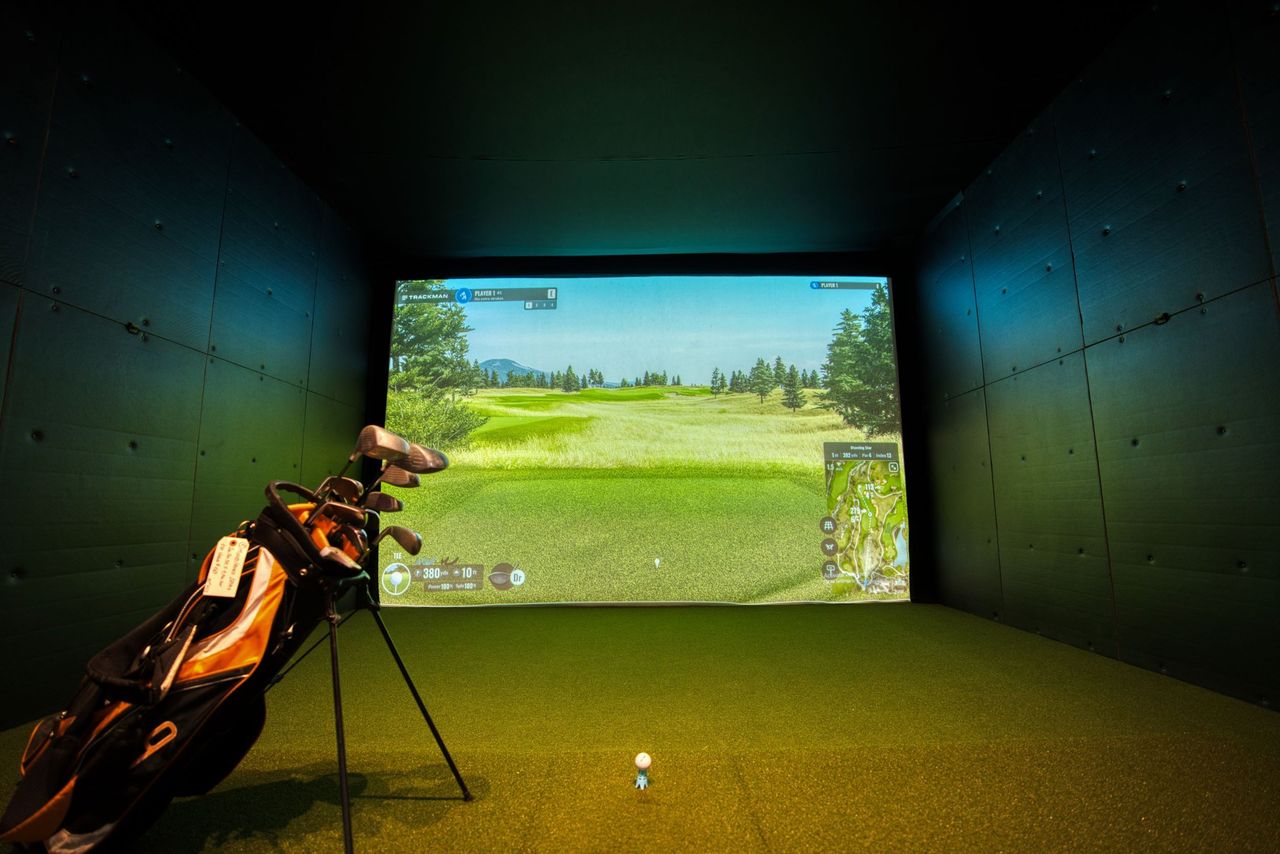
On 26 October 2026, Golf VX published a fresh account of its Quantum indoor golf system, focusing on the moving hitting platform that lets a player physically address uphill, downhill and sidehill lies. The headline figure is more than one million terrain variations. That does not mean Quantum has only just launched: Golf VX formally announced its U.S. introduction on 16 April 2026. October's announcement is best understood as an update on availability and claimed terrain capability, not the debut of a completely new machine.
When the ground becomes part of the simulator
A conventional golf simulator changes the virtual course while the player keeps striking from a level mat. That removes a real-world challenge: on-course lies alter balance, effective loft, alignment and club delivery. Golf VX's 15X Swing Plate is designed to tilt the hitting surface so the physical stance more closely corresponds to the onscreen lie. The manufacturer describes uphill, downhill and sidehill positions, including situations with the ball above or below the feet. Separate striking surfaces are intended to resemble fairway, rough and bunker conditions.
That does not make artificial turf identical to a real course. Natural grass can grab or release the club depending on soil, moisture and grain, while sand depth and firmness have their own effects. A simulator's moving platform can train positional adjustments without reproducing every aspect of turf interaction.
Official specifications, separated from marketing
Golf VX lists a 15-axis terrain plate, more than one million terrain configurations, a Q-Mat display and multi-surface hitting areas. The Quantum Eye measuring system is specified with sensors operating at up to 4,000 frames per second for club-and-ball tracking and a separate swing camera rated at 436 fps. The company's published specifications also mention 28 or more tracked metrics, 4K course projection, a library of more than 400 courses, a touchscreen Q-Console and a Q-Pad for tee height, shot direction and game controls. Golf VX advertises 15 ms response time but does not give an independent testing protocol or clarify precisely which stages of the response are included.
Frame rate describes how a sensor samples action, not how quickly the projection refreshes. Likewise, the million-plus number should not be confused with real golf holes, physical course designs or a million independently measured positions. The company's public material does not detail the counting method.
The 19,000-versus-one-million question
The original U.S. press release of 16 April referred to more than 19,000 terrain variations. The 26 October release now cites more than one million. No public engineering note found in the verified sources establishes whether software expanded the range, the company began counting finer combinations or the comparison uses different definitions. Without that context, stating the system underwent a fifty-fold mechanical improvement would be unwarranted. Maximum tilt angles, calibration tolerances and repeated-position accuracy are also not specified in the published summary.
What a coach could actually use
A teaching professional could ask players to hit an iron with the ball above their feet, plan a shot from a downhill lie or compare their contact patterns across simulated fairway and rough. In theory, matching the physical lie to the virtual ball's position offers more varied practice than a permanently flat mat. The crucial follow-up is whether that realism produces lasting on-course improvement. Neither this announcement nor the checked product page presents independent, controlled evidence of lower scores or a validated head-to-head comparison of measurement accuracy.
The product also offers long-game, short-game and putting practice, plus virtual rounds and competitions. The October release names Golf VX facilities in Arlington Heights, Illinois; North Dartmouth, Massachusetts; and Duluth, Georgia, as places to experience the technology, while also describing residential and commercial sales. Prospective visitors should confirm their chosen bay has Quantum. A complete publicly listed purchase price was not found in the materials checked; room dimensions, installation, support and servicing all matter in a purchase decision.
Editorial verdict
Quantum's most interesting idea is making terrain part of the exercise, rather than merely part of the graphics. Its numerical claims are noteworthy, but not a substitute for evidence about mechanical repeatability, realistic turf interaction or training effectiveness. Buyers should request a hands-on demonstration, installation dimensions, documented movement range, software entitlements, warranty and an itemized quote before drawing conclusions.
Sources: Golf VX announcement, 26 October 2026: https://thegolfwire.com/golf-vx-quantum-real-course-lies-indoors/; manufacturer specifications: https://golfvx.com/simulators/quantum/; initial U.S. launch release, 16 April 2026: https://www.firstcallgolf.com/industry-news/release/2026-04-16/golf-vx-launches-groundbreaking-quantum-simulator-platform-in-the-united-states.