
On October 25, 2026, Florida-based Jeffrey David Golf opened early access to Dream Putt for Meta Quest 3 and Quest 3S. The striking part is not another computer-generated golf course. The player strikes a real ball with a real putter; cameras built into the mixed-reality headset observe the start of the putt, and software completes the ball’s journey across a digitally modeled green. According to the developer, the Quest version needs no external launch monitor, hand controller or club-mounted sensor.
This is specifically the product's Quest release, not the first appearance of Dream Putt. An existing Apple Vision Pro edition uses a separate Square Golf launch monitor for ball measurement. The Quest implementation moves the initial tracking task inside the headset.
Where the physical putt ends
Dream Putt uses the Quest's passthrough cameras to see the player’s putter, ball and surrounding floor. Its official explanation says the headset tracks the real ball for roughly the first foot of roll, approximately 30 centimeters. At that point, a virtual ball takes over and follows the modeled contours and selected speed of a championship green. The user sees the predicted break and finishing position even when the depicted hole is many feet away.
That handoff matters. The entire long-distance roll is not physically measured on turf; it is calculated from a short observed movement and a computer model. A convincing visual representation is not proof of measurement accuracy. At announcement time, the company had not supplied an independent validation study comparing Quest-based readings and virtual outcomes against repeatable real-green trials or reference instruments.
More than a virtual putting carpet
The developer lists putting surfaces based on more than 100 championship courses, over 1,000 drills, and over 50 reconstructions of notable historic putts. Users can select greens, pins and starting positions, adjust the simulated green speed from 4 to 16 on the Stimpmeter, and use training overlays such as contour heatmaps, directional slope arrows, aiming lines, a stroke arc, a tee gate and a calculated ideal line.
Ball-speed and launch-angle readouts, dispersion patterns, make percentages and handicap-adjusted strokes-gained summaries are intended to give players comparable sessions over time. These figures should be interpreted in the context of the underlying camera estimate and simulated turf. They do not automatically have the same validation status as measurements from a calibrated launch monitor.
For putting practice, the interesting distinction is between learning a repeatable starting line—where a real putt and feedback may be particularly useful—and predicting what would happen across a complex 30-foot or 60-foot break. The second task necessarily depends on how closely the digital surface, ball model and estimated initial conditions correspond to actual play.
Hardware requirements, lighting and space
Only Meta Quest 3 and Quest 3S are supported at launch. Dream Putt's FAQ excludes Quest 2 and Quest Pro. Players need their own putter, a real ball, and a dark surface, preferably black or dark green. The recommended mat is at least 3 feet long and 1.5 feet wide. The developer describes about 16 square feet of clear indoor space as sufficient for the experience.
A normally lit room works best. Direct sun, strong reflections from a polished clubhead, high-contrast markings and a light-colored floor can all undermine camera recognition. The company recommends a plain white or yellow ball and a soft cushion about three feet in front of the player to catch the real roll. Menus can be operated with hand gestures, without carrying a controller during the stroke.
Early access is not general availability
The October 25 opening is invitation-based early access. The developer says places are limited and a wider Meta Horizon Store release will follow, without announcing a firm public date. Users can access three free demonstrations per day, each allowing up to 30 putts, with no expiry on the free-demo arrangement. Full access costs $9.99 per month or $99.99 annually, excluding the headset, mat and putter.
For golfers who already own a supported headset, the software could make varied slope and distance sessions more accessible than building an adjustable physical green. For anyone buying hardware specifically for putting, the overall cost deserves a separate calculation. Neither price nor the number of represented courses establishes an improvement in scoring.
Safety, data and the unanswered test
A real golf ball still needs a physical stopping point and sufficient space to avoid accidents. A projected break does not reproduce grass friction under the player’s feet or teach outdoor green-reading without assistance. The developer's privacy policy, effective October 14, 2026, says camera imagery used for ball tracking is processed on the device rather than uploaded as video, while putting metrics and session results can be retained. That is a published policy claim, not an independent security audit.
The practical verdict: Dream Putt combines a genuine strike and short observed roll with a potentially far longer simulated putt. That is a noteworthy training-system design, not evidence that mixed reality has already replaced real-green practice. The most useful next evidence would be independent tracking accuracy tests across ball colors, light levels, speeds and putter types.
Sources: Jeffrey David Golf release dated October 25, 2026 — https://thegolfwire.com/dream-putt-early-access-meta-quest/; official specifications and FAQ — https://www.dreamputt.app/; privacy notice — https://www.dreamputt.app/privacy.
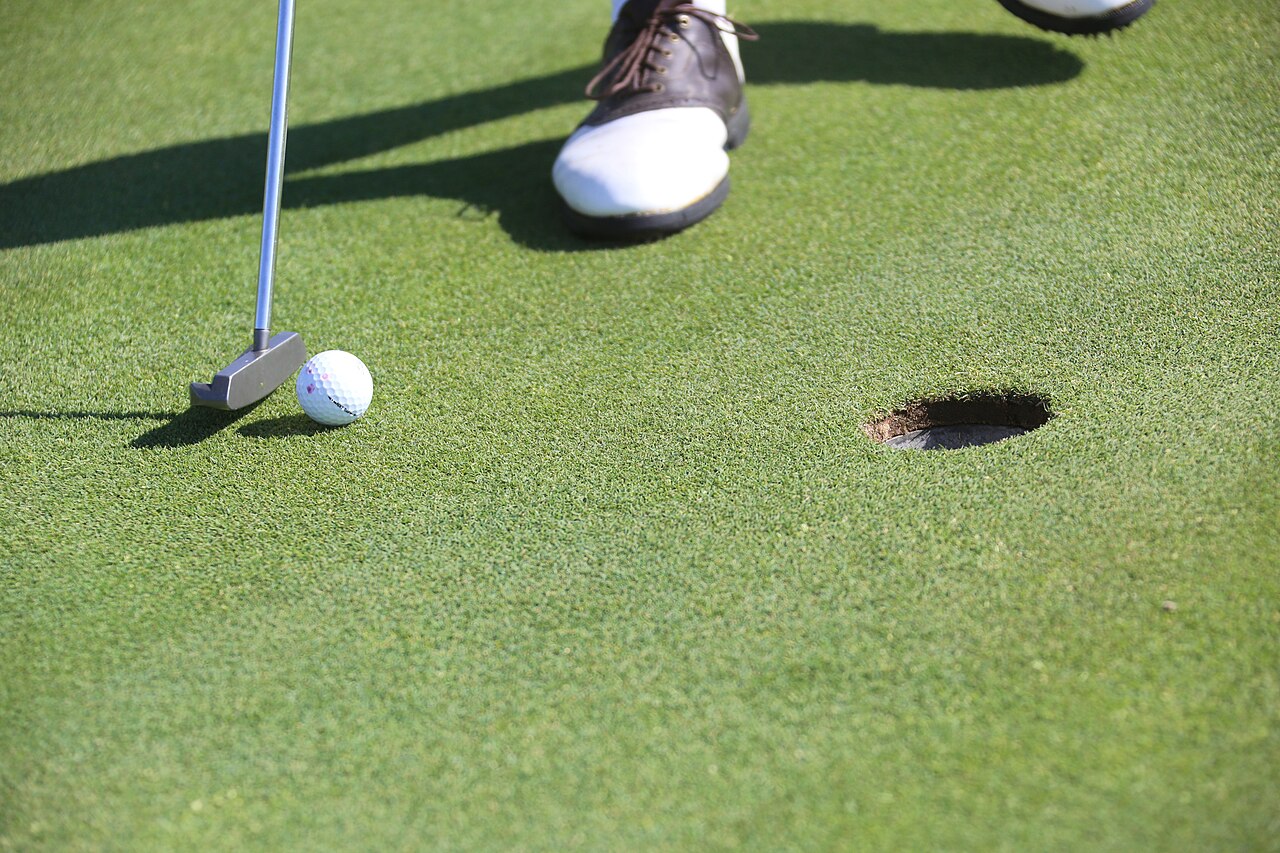
Illustration: Larry D. Moore / Wikimedia Commons, CC BY 4.0, https://commons.wikimedia.org/wiki/File:Putting_Green_Butler_Park_Pitch_and_Putt_Golf_Course_Austin.jpg. The photograph depicts an ordinary putting green, not Dream Putt.
Read more on this topic
GameGolf Explore opens 36,000 golf courses to everyone: what changes for GPS shot tracking
Game Your Game launched Explore Golf Course on 26 October 2026, offering free access to hole maps, recorded rounds and leaderboards. We separate the new web feature from KZN AI hardware, subscriptions and unverified performance claims.

Two gates on the green: how to investigate a missed putt
Tour putting coach Stephen Sweeney uses two gates to reveal where a breaking putt strays from its intended line. Learn the setup, limitations and an optional 24-putt self-check.

Train the Strike, Not Just the Swing: Adam Young's 8 Practice Ideas and a 32-Shot Check
Coach Adam Young suggests eight ways to train impact, starting lines and shot selection. We explain the limits of the advice and offer an original 24-shot plus eight-putt check.
Putting and neurofeedback: what 12 trials involving 424 golfers really found
A review of 12 randomized trials (424 participants) found encouraging putting-training results, but 94% heterogeneity makes sweeping claims unsafe. We examine EEG neurofeedback and a practical 24-putt observation routine.