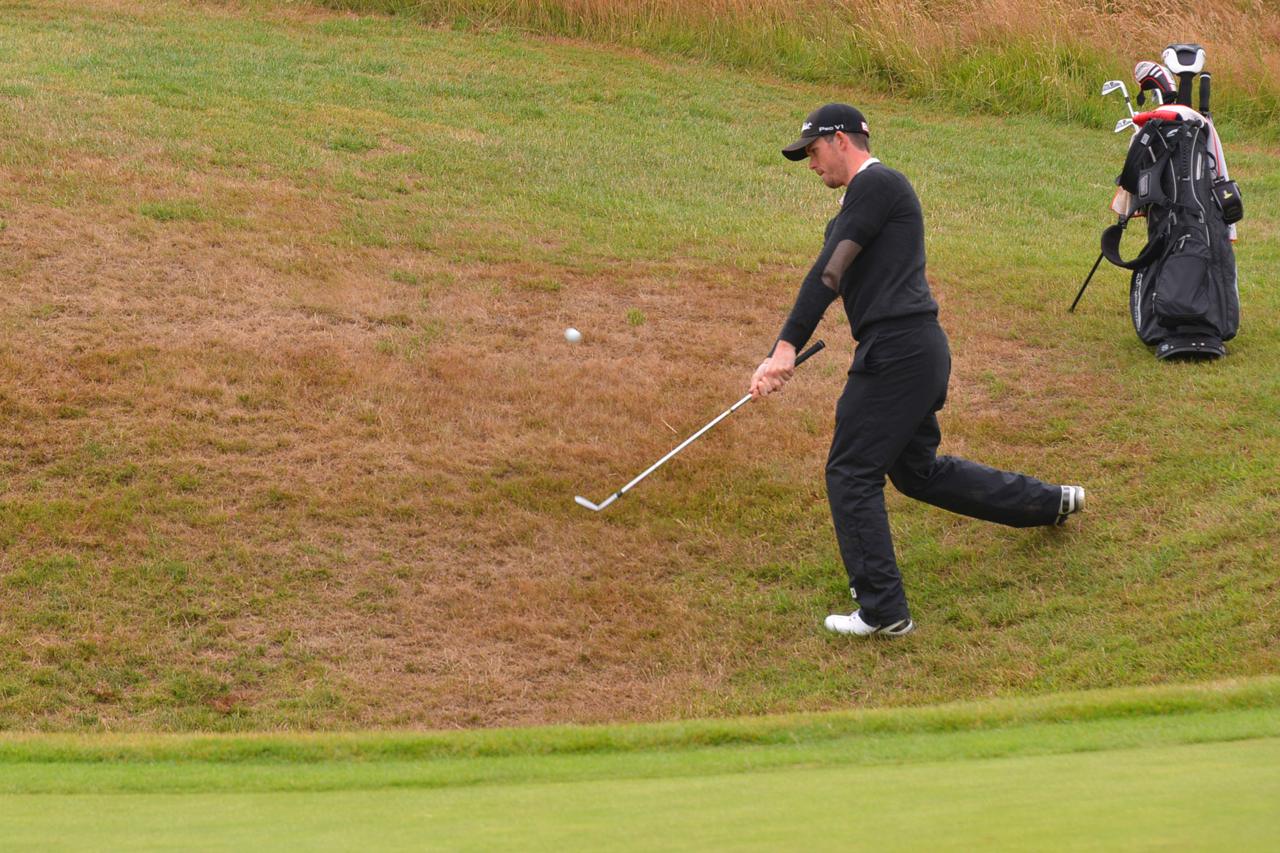
When a high shot makes sense
Imagine being just off the green with a bunker, bank or other obstacle between your ball and a flag that has little room behind it. A flop shot seeks a high launch and relatively soft landing. It is a specialised choice, not the standard answer to every short-game problem.
In an article published by GOLF.com on October 17, 2026, Maddi MacClurg reported two flop-shot approaches demonstrated by GOLF Top 100 Teacher Debbie Doniger. These are coaching techniques, not findings from a controlled trial, and they do not guarantee improvement for every player.
Method one: a more manageable high shot
For Doniger's simpler version, open the wedge face slightly. Position the ball in the middle of the stance or marginally toward the lead foot. Raise the handle a little, so the club's toe sits lower. Keep the arms wide during both halves of the motion, using something like a half- or three-quarter-length swing. Rather than stabbing down or trying to flick the ball skyward, allow the sole of the club to move through the grass.
The aim is to combine loft with reasonably predictable contact. It is not a cue to scoop with the wrists. Turf firmness, grass length, club bounce and each player's delivery can change the result. Test the movement first from a comfortable practice lie.
Method two: higher flight, tighter margin
For an advanced flop, Doniger suggests a wider stance with the lead knee over the lead foot. Open the face further and lower the handle. In her demonstration, these adjustments help introduce more loft while accounting for the directional effect of an open face. Keep the arms relaxed and let a somewhat larger swing unfold at an unhurried tempo.
An unhurried tempo is not the same as slowing the club abruptly at impact. Deceleration driven by fear can make strike less reliable. Doniger also demonstrates a thumbs-off rehearsal to encourage a freer clubhead release. Treat that as a slow, ball-free rehearsal in a clear area; use a secure conventional grip for real shots so the club cannot slip.
Choosing the sensible option
Where there is plenty of green between the ball and hole, a standard chip or even a putt from the fringe is often less demanding. Thin, firm turf can make a wide-open face harder to use; thick rough brings different contact problems. Assess the lie, the obstacle, available landing space and your own success rate before selecting a high-risk shot.
Original GOLFTWITT practice: 24 balls
This is an editorial observation exercise, not a scientifically validated training protocol.
Set up: On a safe short-game area, select a modest carry distance and a good lie. Mark an intended landing zone away from your stroke path. For each ball, note strike quality, first landing point, finishing position and any conspicuous thin or heavy contact.
Set A — eight balls: Try Doniger's simpler setup with a modestly open face, wide arms and smooth movement. Record results instead of rating only the feeling of the swing.
Set B — eight balls: Test the wider stance, lower handle and more open face. Attempt it only where an imperfect shot will be safe. Compare strike reliability and landing dispersion with Set A; maximum height alone is not success.
Set C — eight balls: Alternate simulated situations. Some require carrying a notional obstacle and stopping relatively quickly; others allow a lower-running chip. Before each attempt, decide which shot is actually justified and assess the decision as well as execution.
The useful outcome is knowing which shot you can repeat and under which conditions—not a promise of miraculous spin, height or lower scores.
Source: Maddi MacClurg, “Top teacher shares 2 ways to hit a flop shot,” GOLF.com, October 17, 2026: https://golf.com/instruction/top-teacher-2-ways-hit-flop-shot/. Doniger's coaching ideas are distinguished from GOLFTWITT's original practice framework and editorial cautions.
Read more on this topic
Launch Monitor Numbers vs. Real Golf Learning: A 24-Shot Self-Check
A launch monitor can measure a shot, but does that mean a skill was learned? We examine MyGolfSpy's October article and offer a careful 24-shot practice exercise.
Do High-MOI Drivers Really Help Poor Ball-Strikers More? What 99 Testers Reveal
A seven-year MyGolfSpy analysis of 99 testers found no special extra carry benefit for frequent mishitters, but about 6% tighter carry spread from more forgiving drivers. Here is how to interpret and test that.
Longer Pitch Shots Without Guesswork: An LPGA Lesson and a 24-Ball Distance Check
LPGA Professional Kelley Brooke highlights setup and a landing target when working on longer pitch shots. We separate her published lesson from our own 24-ball distance-control check, without promising improvement.

Is There a Perfect Putting Practice Difficulty? What a Trial of 150 People Found
A randomized putting study involving 150 people found no single optimal practice difficulty across three success-rate bands. We explain the limits and offer a careful 30-putt observation routine.