The golfer, the task and the equipment belong in the same conversation
A study published on 4 June 2026 in the International Journal of Sports Science & Coaching asked what happens when golf instruction and club fitting are viewed from women's actual experiences. Lindsey Legg and colleagues interviewed six women golfers and nine coaches, then analyzed the themes using a constraints-led framework. This was a qualitative interview study, not a randomized trial comparing swing techniques or club specifications. Its value is in asking better coaching questions—not in declaring one scientifically proven swing for all women.
What the interviews revealed
Golfers differ in height, strength, mobility, speed, skill, preferred shot shape, comfort and goals. A movement cue that helps one player may not suit another. Participants described problems that arise when an assumed 'ideal' movement, often drawn from men's elite golf, is applied without considering an individual's capabilities. Some golfers also recalled fitted clubs that looked suitable on paper but felt awkward during play.
A revealing disagreement concerned club weight. Some coaches felt women were frequently given clubs that were too heavy; others described clubs that were too light. Those views reflect different player populations and do not yield a universal prescription. Shaft length, total mass, balance, flex and grip should be evaluated against actual shots, rather than selected solely by a 'ladies' label. The study also explored coaching environments: access to equipment, being heard by a coach and feeling free to experiment can shape a golfer's learning experience.
Questions worth taking to your next lesson
Start by agreeing on a specific performance problem: strike location, dispersion, carry consistency, directional control or an uncomfortable movement. Ask what observable sign would tell you whether a proposed change works. Is the goal more centered strikes, a narrower pattern, or more repeatable distance? A coach's cue is most useful when it addresses a clear problem and can be revisited with evidence, rather than being offered as a generic position everyone must copy.
GOLFTWITT's editorial 24-shot check
The following is an editorial practice idea, not a protocol tested by the researchers. With one club and a realistic target, record carry if available, start direction, left–right dispersion and comfort on a 1–5 scale. Hit 6 baseline shots with your usual routine. Then hit 6 shots using one agreed setup or movement adjustment. Return to 6 baseline shots, and finish with 6 shots alternating targets to add a game-like demand. Compare the typical result and distribution, not just the single longest or straightest ball. If comparing two clubs, repeat the exercise under similar conditions and avoid conclusions from isolated strikes.
Change only one major variable at a time. Altering grip, shaft, stance and tempo simultaneously makes differences hard to interpret. Stop if an adjustment causes pain, and seek professional guidance if symptoms persist.
What the paper does—and does not—establish
Interviews with 15 people can reveal useful experiences but cannot prove that one club specification increases distance or that a particular swing model reduces injury risk. The study did not experimentally test the 24-shot check above. It was supported by Loughborough University and PING Inc., and a coauthor was affiliated with PING—relevant context for readers assessing conclusions about equipment. The central practical lesson is individualized observation, not a guaranteed scoring improvement.
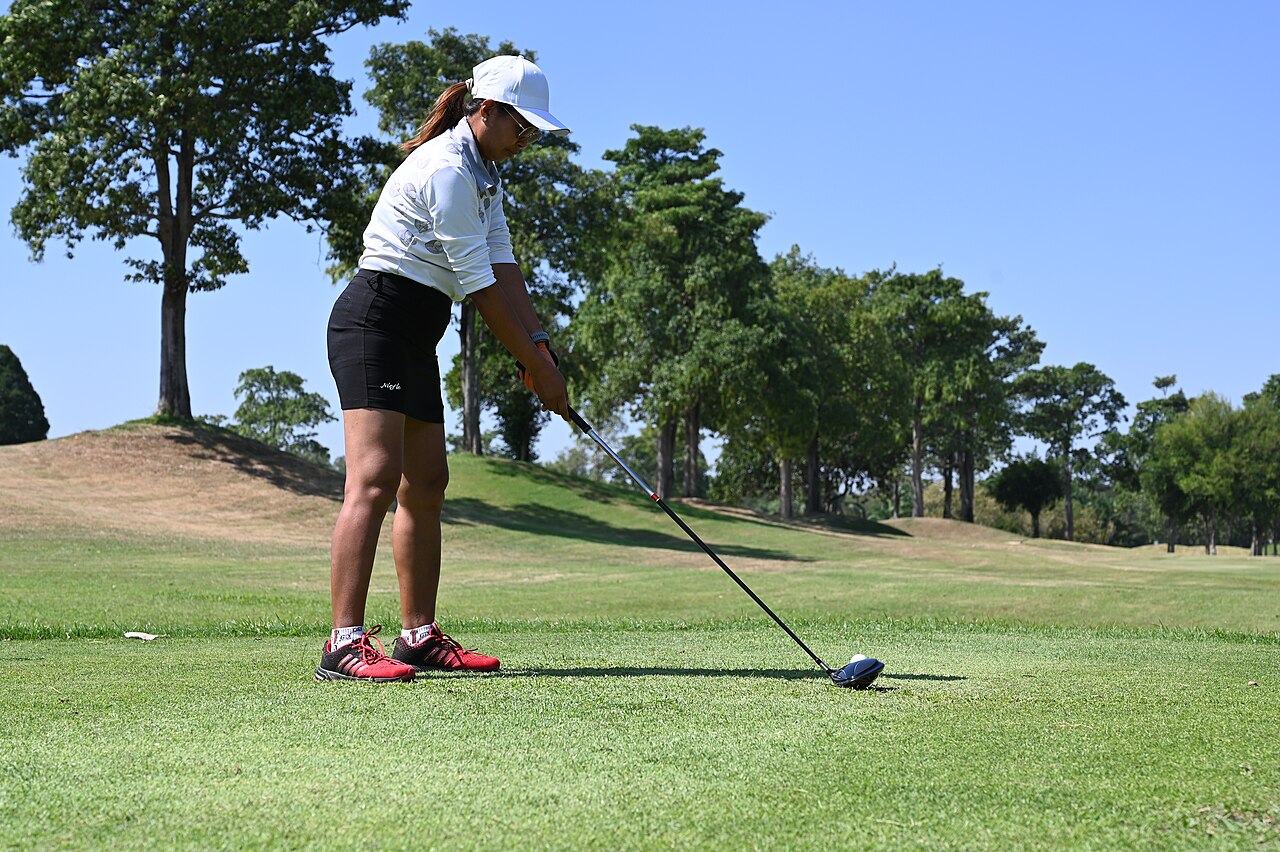
Source: Legg L. et al., “Exploring women's golf performance, swing biomechanics, and golf equipment: A constraints led approach,” International Journal of Sports Science & Coaching, 4 June 2026, DOI 10.1177/17479541261452450. The accompanying photo is illustrative and does not depict study participants.
Read more on this topic

The timing of ground force: TPI's Pelvic Punch drill and a 24-shot practice check
TPI explains why the timing of force against the ground matters as much as its magnitude. Dr Greg Rose's Pelvic Punch exercise, its limits, and an original 24-shot practice check.

Can a Smartwatch Analyse a Full Golf Swing? Evidence From 36 Golfers
A 36-golfer experiment tested full-body motion estimates from one wrist sensor. We explain the accuracy, limitations and a practical 18-shot observation log.
Launch Monitor Numbers vs. Real Golf Learning: A 24-Shot Self-Check
A launch monitor can measure a shot, but does that mean a skill was learned? We examine MyGolfSpy's October article and offer a careful 24-shot practice exercise.
Train the Strike, Not Just the Swing: Adam Young's 8 Practice Ideas and a 32-Shot Check
Coach Adam Young suggests eight ways to train impact, starting lines and shot selection. We explain the limits of the advice and offer an original 24-shot plus eight-putt check.