On 27 October 2026, golf coaches Erik J. Barzeski, Jayson Nickol and Tyson Deskins released episode 086 of The Spin Axis, The Trail Arm — Up, Not Around. Their question is deceptively simple: where does the trail arm actually go during the backswing? For a right-handed golfer the trail arm is the right arm; for a left-handed golfer it is the left.
The arm does not merely wrap behind the chest
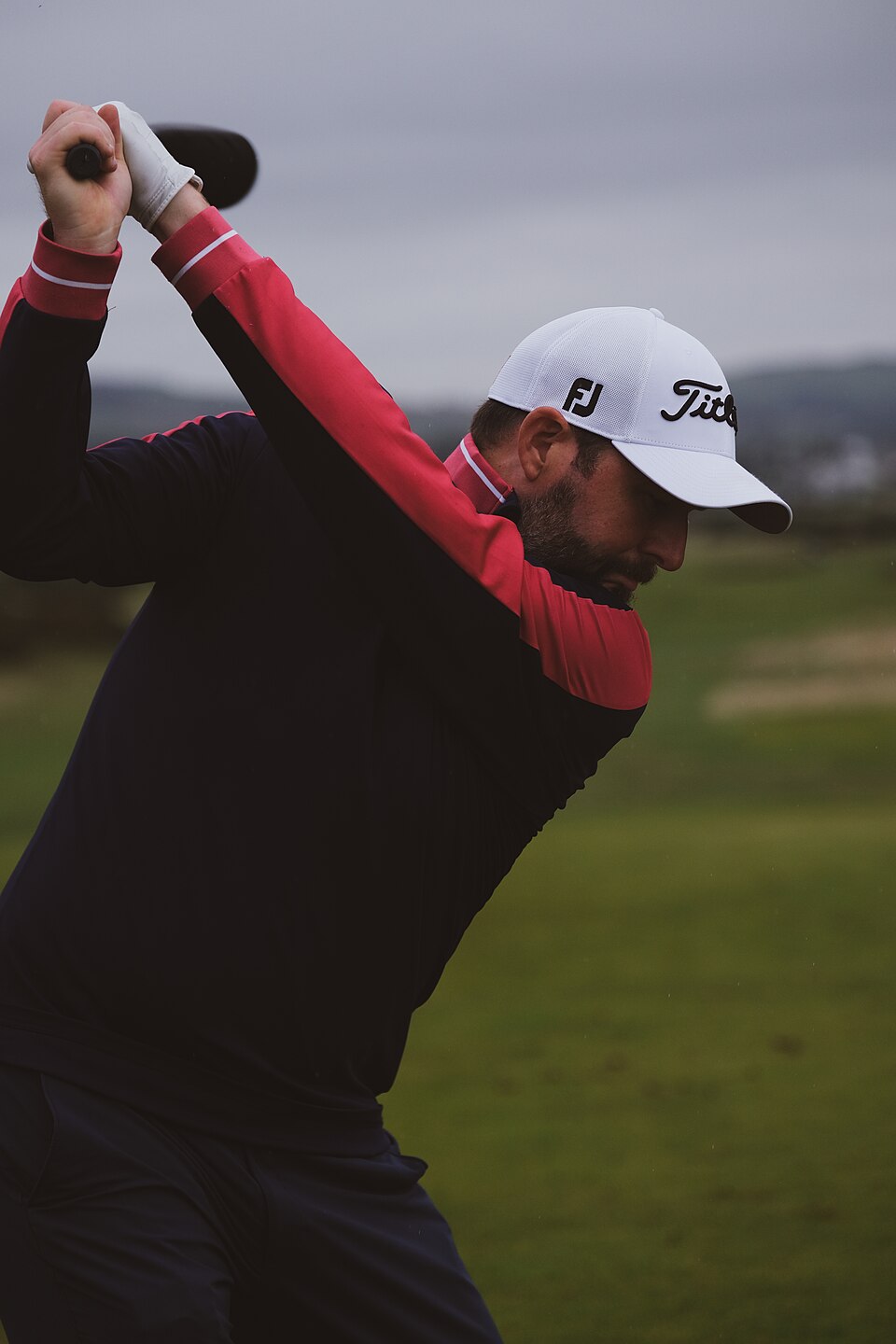
It is tempting to describe the backswing as both arms circling the torso. The coaches describe a more nuanced motion: the trail arm also lifts relative to the turning torso. Shoulder abduction and rotation, elbow flexion and the movement into transition all play a part.
This is not an instruction to lift the arm straight overhead. Position varies with individual anatomy, grip, mobility and swing pattern. The useful distinction is between what the torso does and what the shoulder and elbow do—not copying one frozen image of a Tour player.
Is a 90-degree trail elbow mandatory?
The episode notes that trail-elbow bend is commonly around 90 degrees or less. That is a description, not a universal checkpoint. Do not force the elbow to an exact angle, or assume that every club and every golfer should create the same shape. Excessive conscious control may make the movement less comfortable.
When reviewing video, remember that a camera looking down the target line can make an upward-moving arm appear to wrap behind the body. Use more than one view if possible, and avoid treating a two-dimensional image as a complete measurement of joint motion.
The trap of pulling the elbow back too early
Tyson Deskins warns about excessive early retraction of the trail arm during the takeaway. A golfer can make the elbow disappear behind the torso without creating a coordinated backswing. But the opposite cue—clamping the elbow tightly against the ribs throughout—should not become an inflexible rule either.
During transition and the downswing, the elbow works more toward the side and then extends. The coaches' point is that the arm's action is not simply continuous rolling around the body. That observation does not mean that a player should consciously yank or drop the elbow with force.
A 12-ball observation session
The following is an original GOLFTWITT practice adaptation, not a protocol reported by the podcast.
Phase 1: six slow, ball-free rehearsals. Take a mid-iron and make sure the area is clear. From your normal address, move to a half backswing and pause. Use a mirror or record from face-on and down-the-line. Watch for whether the trail arm rises as the chest turns, or whether the elbow is pulled sharply behind the body immediately.
Phase 2: six short shots. Hit comfortable partial shots with the same club. Keep grip and effort familiar. After each ball, note the strike quality, start direction and shoulder comfort. Resist chasing speed or an exaggerated position.
Phase 3: six normal shots. Return to your usual swing length. Compare typical contact and miss pattern—not just the single best result. Stop if the movement causes pain, worsens balance or feels strained; a qualified coach can help determine whether any change is appropriate.
Never force shoulder range of motion or practice through pain.
What the lesson does—and does not—establish
This episode shares experienced coaches' interpretation of swing mechanics; it is not a controlled scientific trial. Likewise, twelve shots cannot establish a reliable gain in clubhead speed or accuracy. The useful takeaway is to distinguish torso turn, shoulder lift and elbow bend before undertaking a technical rebuild.
Source: The Spin Axis, episode 086, The Trail Arm — Up, Not Around, 27 October 2026.