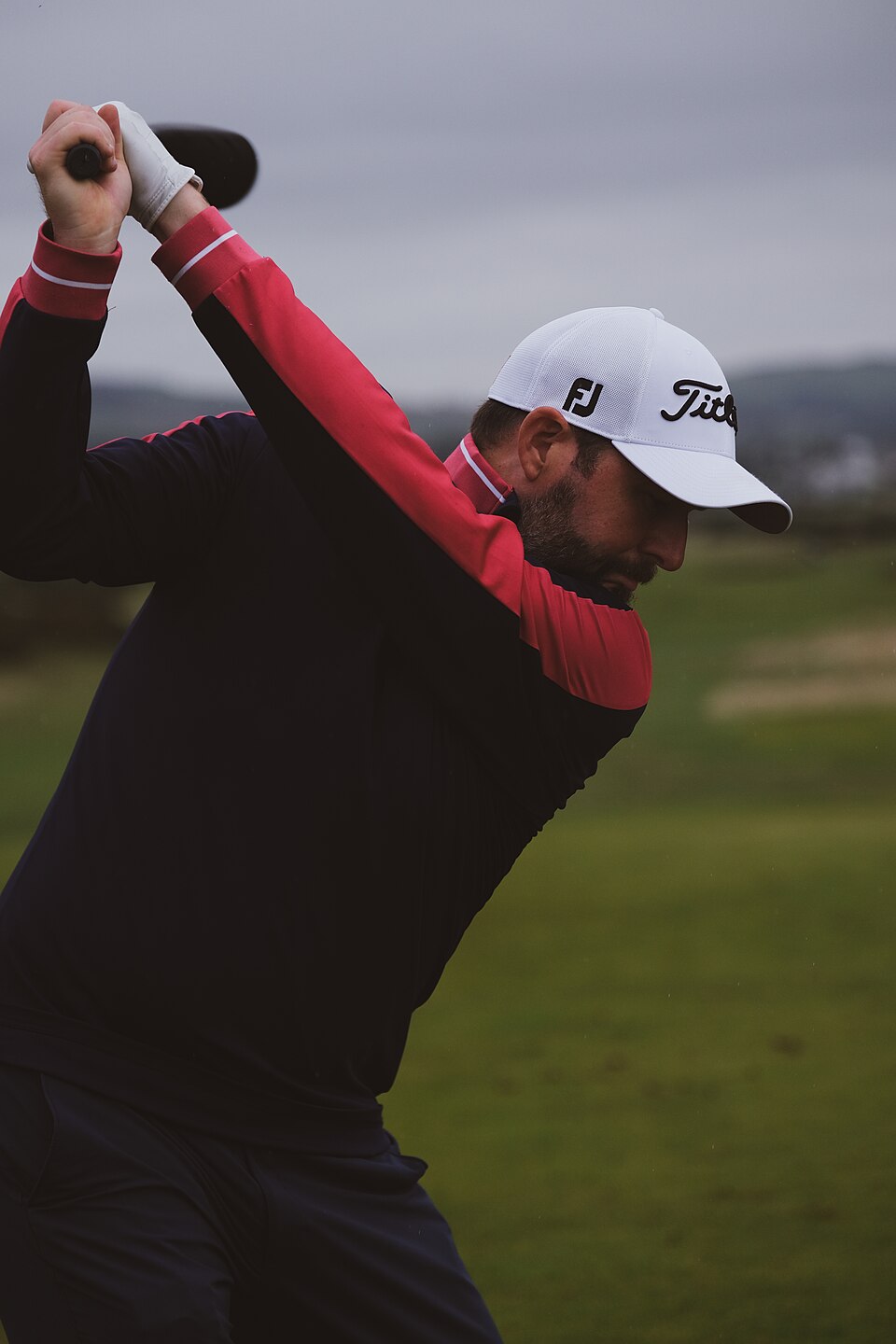
When your backswing feels shorter than it used to, the temptation is to pull the club farther back with your hands. But a longer-looking motion does not necessarily mean that your torso has turned more effectively.
In an article published by Golf Digest on 26 October 2026, writer Ron Kaspriske presents four movement exercises from Karen Palacios-Jansen, a Golf Digest-certified golf fitness trainer who works with golfers at CardioGolf Studio in Mooresville, North Carolina. Her focus is on a comfortable body turn while retaining the forward inclination of the golf posture—not on copying John Daly's exceptionally long backswing.
Why simply lifting the arms farther is not the goal
Backswing length is influenced by thoracic and hip rotation, arm movement, mobility and the shot being played. Reaching past a comfortable turn can cause a golfer to rise out of posture or change the arm structure to make the club travel farther. That does not mean every compact backswing is a fault: a shorter, repeatable swing may be entirely appropriate. Nor does a flexibility drill, by itself, prove that clubhead speed or scoring will improve.
1. Seated hip hinges
Sit toward the front of a stable chair, with your feet planted. Lengthen your back and tip your chest slightly forward while your hips move back. Avoid tucking the pelvis underneath. From there, gently rotate your shoulders: the lead shoulder moves down and across; the trail shoulder moves back and upward. Observe whether the tilted posture remains comfortable. This is a movement rehearsal, not a contest to achieve maximum rotation.
2. Turn and reach
In a golf-style stance, hold a pole upright with the trail hand placed above head height; the elbow can remain slightly bent. Reach the lead hand down and across the body, then upward toward the trail hand while your back gradually turns away from the target. Keep the original forward inclination instead of standing up to reach higher. Try a few controlled, gentle repetitions rather than forcing an end position.
3. Flowing back-and-high arm swings
Maintain a relaxed golf posture and swing one arm behind you in a smooth, unhurried movement. Let the trail shoulder and hip rotate back as the arm travels. Continue toward an imagined follow-through and notice how the lead side moves. The source describes doing this with no weight or a very light dumbbell. The aim is coordination, not a heavy strength set or a painful shoulder stretch.
4. Head-rotation backswing rehearsal
Address an imaginary ball, gently turn your head away from the target and look behind you, then make a slow practice backswing. Bring your eyes back toward the imagined ball. This may help you notice whether tightly fixing your gaze creates unnecessary neck tension. It is a practice rehearsal without striking a ball—not a recommendation to look away deliberately at impact. Stop if the motion causes dizziness or neck discomfort.
GOLFTWITT's five-minute observational check
The following is our editorial self-check, not a scientifically validated intervention or a routine endorsed by the coach. Begin with two slow, ordinary practice backswings and note your balance, forward tilt and comfort. Perform three to five smooth repetitions of each of the four exercises, staying within a pain-free range. Finish with two more practice backswings. Compare the ease of turning and your ability to keep a balanced posture; do not chase a greater backswing angle at any cost.
If you record video, use the same camera position and distance before and after: a different perspective can make a similar motion look different. One warm-up session cannot demonstrate lasting skill improvement. Over several practice days, track contact quality and start direction if you want to investigate whether anything transfers to hitting golf balls. Anyone with persistent back or neck pain, a recent injury or a clinician-imposed limitation should seek appropriate professional advice rather than push their range.
Source: Ron Kaspriske, Golf Digest, 26 October 2026; accessible syndicated article: https://sports.yahoo.com/articles/short-tight-simple-exercises-old-151049866.html . Photo: archival backswing photograph, not a record of Palacios-Jansen's lesson.
Read more on this topic
Launch Monitor Numbers vs. Real Golf Learning: A 24-Shot Self-Check
A launch monitor can measure a shot, but does that mean a skill was learned? We examine MyGolfSpy's October article and offer a careful 24-shot practice exercise.
Train the Strike, Not Just the Swing: Adam Young's 8 Practice Ideas and a 32-Shot Check
Coach Adam Young suggests eight ways to train impact, starting lines and shot selection. We explain the limits of the advice and offer an original 24-shot plus eight-putt check.

The timing of ground force: TPI's Pelvic Punch drill and a 24-shot practice check
TPI explains why the timing of force against the ground matters as much as its magnitude. Dr Greg Rose's Pelvic Punch exercise, its limits, and an original 24-shot practice check.

Can a Smartwatch Analyse a Full Golf Swing? Evidence From 36 Golfers
A 36-golfer experiment tested full-body motion estimates from one wrist sensor. We explain the accuracy, limitations and a practical 18-shot observation log.