On 27 October 2026, Golf Monthly published Elliott Heath's breakdown of Shot Scope statistics comparing scratch golfers and players with a handicap of 10. The most useful lesson is not to imitate an elite amateur's swing. It is to measure where your own strokes are being lost and choose practice accordingly.
Driver distance versus fairways
The reported average driver distance is 285 yards for scratch players and 259 yards for 10-handicappers — a gap of 26 yards. The difference in fairways hit is much smaller: 50% versus 48%. This does not mean accuracy is unimportant. A shot finishing in light rough and one entering a penalty area both count as missed fairways, yet their effects on the score can be very different. Distance is helpful only when the next shot is playable from the resulting lie.
Approach play separates the groups
In the reported data, greens in regulation (GIR) are 59% for scratch golfers and 32% for players with a handicap of 10. Across a hypothetical 18-hole round, that is roughly 10.6 versus 5.8 greens. Average approach proximity is 65 feet against 104 feet. A better practice question than “How hard can I swing?” may be “Which club and carry distance let me reliably find a sensible area of the green?” The flagstick is not always the safest target.
Short game and putting matter as well
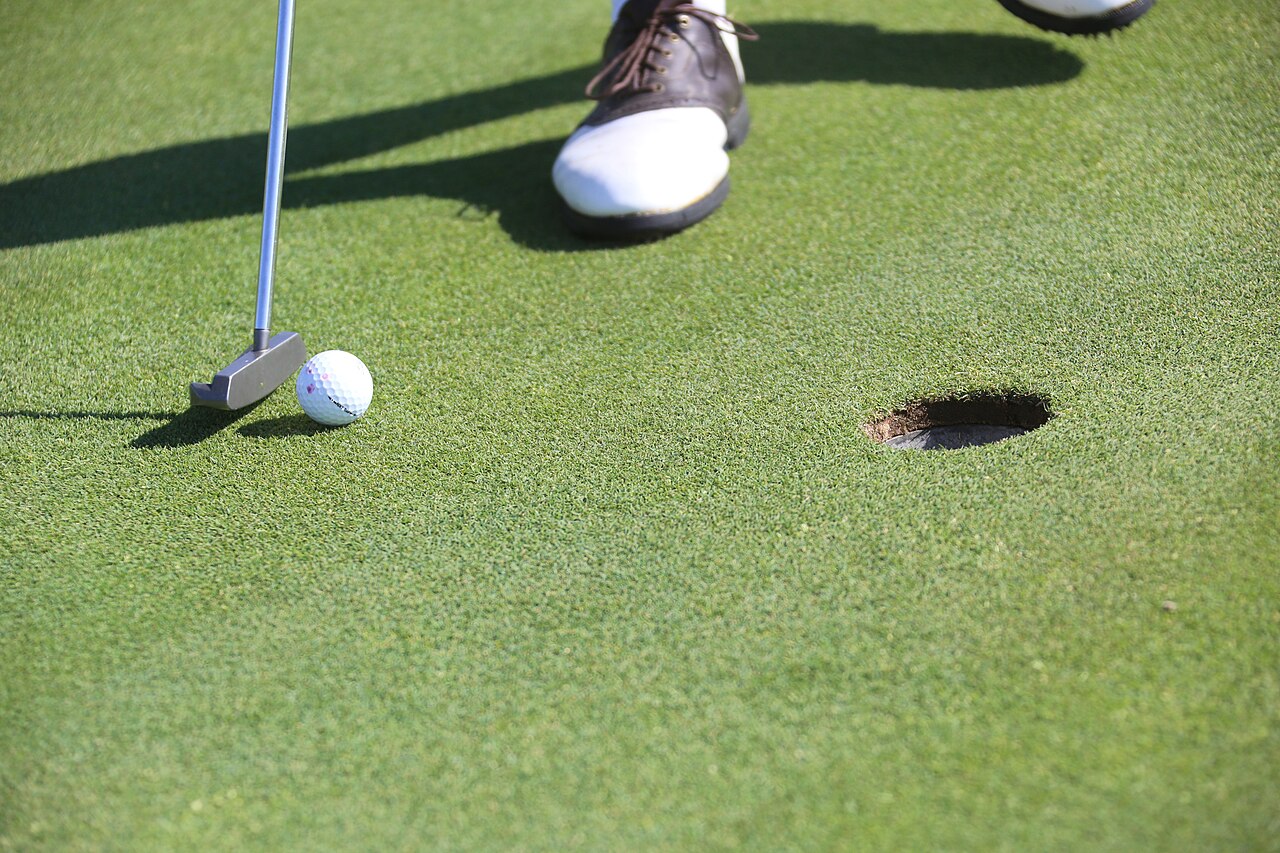
The up-and-down rate from inside 50 yards is 54% for scratch players and 39% for the 10-handicap group. Here, up-and-down means finishing the hole in two strokes after a missed green, usually a short-game shot followed by a putt. The groups average 0.9 and 1.5 three-putts per round respectively. A chip does not need to stop inches from the hole to be useful. Similarly, a well-paced long putt can be valuable even when it stays out of the cup.
Three-round self-audit and focused practice
First, record three rounds. For each hole, note penalty strokes following tee shots, GIR, whether a second chip or pitch was needed, total putts and the approximate length of the first putt. Three rounds are only a small personal sample, not a definitive assessment.
Second, pick the biggest source of lost strokes. Frequent tee-shot penalties suggest working on safe targets and repeatable driver contact, not speed alone. For low GIR, hit 18 shots with a single iron on the range, logging carry, left-right misses and dispersion around a conservative target. If three-putts are common, hit 12 long putts while measuring the remaining distance, then 12 shorter putts while observing the start line. For chipping, use 12 shots from a consistent lie and record the distance remaining to the hole.
Third, retest in comparable conditions. Track the same measures over later rounds and consider hole length, wind, firmness and course setup. One good range session does not prove a method works. A qualified coach can help assess persistent technical problems and any substantial swing changes.
What these statistics cannot prove
This is a descriptive comparison of Shot Scope users, not a randomized training experiment. The feature does not provide enough detail on the exact makeup of the two groups to apply the figures universally across ages, genders or courses. A scratch handicap does not imply shooting exactly even par every round. Nor does the 26-yard difference show that gaining 26 yards would automatically take an individual's handicap to zero.
Takeaway: Measure your own weaknesses, make one area the focus of practice, and evaluate changes with repeated on-course observations.
Source: Elliott Heath, Golf Monthly, 27 October 2026, using Shot Scope data.