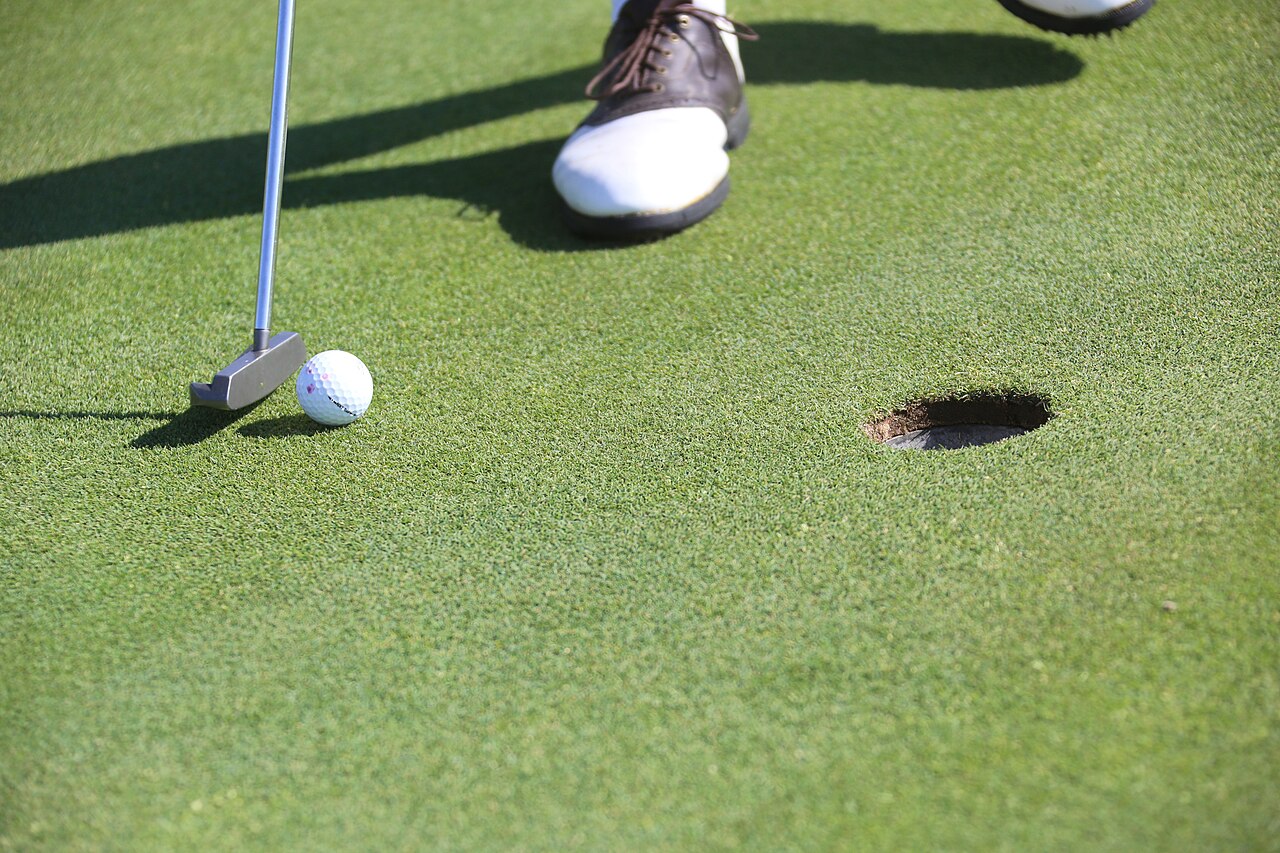
A putt misses the hole. Was the green read wrong, did the ball start on the wrong line, was the pace unsuitable, or did the putter fail to deliver the planned stroke? The answer may feel obvious to the player. Yet a study appearing in the October 2026 issue of the International Journal of Sports Science & Coaching found that golfers and their coach often judged the same putt differently.
What the researchers measured
L. M. Carey and colleagues studied 11 right-handed golfers, six men and five women, in Scotland. Each completed 12 outdoor putts in winter and another 12 in summer. Distances ran from 6–9 feet (about 1.8–2.7 metres) to 18–20 feet (about 5.5–6.1 metres), with different slopes and breaks.
Following each stroke, the golfer and a single experienced PGA coach separately recorded yes/no assessments of five elements: green reading, setup, pace, aim point and execution. The coach also had access to TrackMan feedback. The research therefore examined agreement about why a putt unfolded as it did, not merely whether the ball dropped.
The paper was first published online on 28 February 2026, then appeared in Volume 21, Issue 5 (October 2026). It was an observational assessment, not a trial of a new coaching intervention.
The disagreement was specific
The authors used Cohen's kappa (κ), a statistic that accounts for chance agreement. Pooled across the sessions, agreement was essentially absent for green reading (κ = 0.005). It was slight for start line (0.124) and execution (0.167). Agreement was greater, but far from complete, for aim point (0.281) and pace (0.383).
One recurring pattern was the golfer marking an aspect successful while the coach judged it unsuccessful. That does not make one coach an infallible referee: the coach had additional measurements and the study included only one coach. The important lesson is that the golfer and coach may not share the same definition of a good putt.
Practice hours did not significantly predict performance in this small dataset. This is not evidence that practice is pointless. Quantity of practice is not the same as its quality, and the sample was too small for sweeping conclusions.
A 12-putt self-assessment session
The following is a GOLFTWITT editorial exercise, not a training method validated by the study.
First, create variety. On a practice green, select four short, four medium and four long putts, mixing uphill, downhill and breaking lines. Keep other golfers safe and respect the practice area's rules.
Second, state the plan before putting. Identify your intended start line, aim point and pace. Keep your usual putting grip and stroke; this is a perception exercise, not an instruction to rebuild your technique.
Third, assess separate components. Immediately after each stroke, note whether your green read, intended start line, pace and execution matched your plan. “Made” versus “missed” is a result, not a complete diagnosis.
Fourth, seek independent feedback. Where possible, ask a coach to make a separate assessment. Video can help reveal some mechanical details, but cannot by itself verify a green read. Compare observations and discuss disagreements without automatically assuming either person is right.
Finally, look for patterns. One missed putt is weak evidence. Repeated problems with pace or start line may help you choose one clear topic for your next practice session.
What the evidence does not establish
With 11 participants, one coach and varying seasonal green conditions, the study cannot show that this exercise lowers scores or that one party always judges putts better. Its useful message is narrower: learning to distinguish line, pace, read and execution can make coaching conversations more precise.
Original research: Carey et al., Exploring agreement between golfers and coach in evaluating a putt, International Journal of Sports Science & Coaching, DOI: 10.1177/17479541261426912.