Watching the outcome before the ball is away
In an article published by Golf Digest on October 30, 2026, Charley Hull identified a habit she frequently sees among amateurs during pro-ams: looking up to see whether a putt will fall before the stroke is complete. An early head movement does not explain every missed putt, but it may alter posture at the very moment the putter reaches the ball.
For a teaching perspective, Golf Digest spoke to Mai Dechathipatmai of KOHR Golf Academy in Massachusetts, a coach recognised among the publication's young instructors. Her explanation links two ideas that golfers often separate: maintaining a useful setup through impact and keeping attention on the task rather than the result.
What can go wrong at impact
When the eyes move prematurely towards the hole and the head and shoulders follow, the player's posture and putter delivery may change. The putterface direction at impact is a major contributor to the ball's starting line. This does not mean rigidly freezing the neck throughout the ball's roll. It means avoiding an unnecessary movement before and through contact.
Dechathipatmai also describes an attentional effect: a golfer who peeks early may already be thinking about whether the putt has gone in rather than feeling the stroke. She sometimes practises putting with her eyes closed to attend to contact and rhythm. That is a coaching cue, not proof of a guaranteed score improvement for every player.
GOLFTWITT practice: twelve putts, one observation
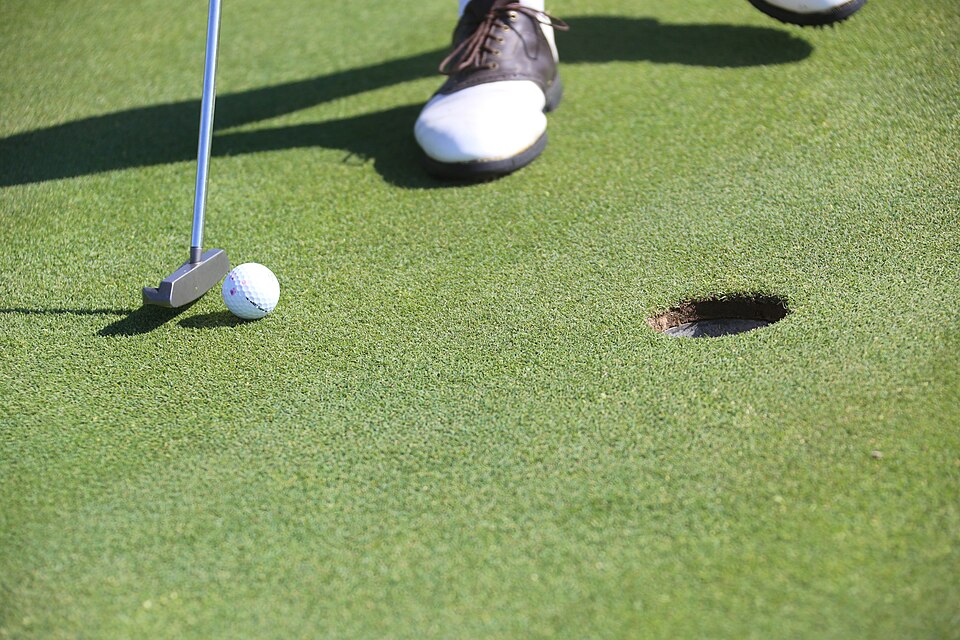
On an empty practice green, place a ball roughly one metre from the hole. Play three groups of four putts. First, putt in your usual way and record the makes. For the second group, keep your attention at the ball through contact and only then allow your gaze to follow it. In the third, keep the same visual sequence while paying particular attention to the smoothness of the putting stroke. Before striking a ball, you may rehearse a few movements without a ball with your eyes closed, as a way to observe the feeling of the putter.
Record both whether the putt went in and how cleanly the ball was struck. A perfect four-putt sample proves very little; compare several sessions rather than treating a small improvement as conclusive. Stop if the cue produces uncomfortable tension in the shoulders or neck.
Not the same as Quiet Eye
A previous GOLFTWITT lesson discussed Quiet Eye: where visual attention settles before the putt. Hull and Dechathipatmai are addressing a related but distinct issue — premature head movement during the stroke.
Source: Keely Levins, Golf Digest, October 30, 2026. The twelve-putt comparison is an editorial practice suggestion, not a validated clinical protocol.