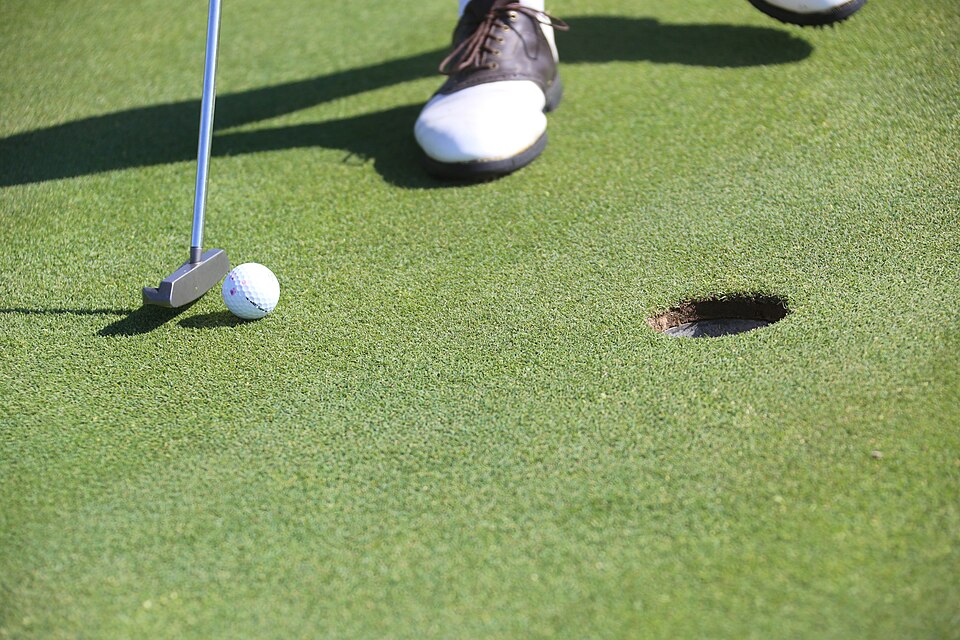
Putting: check ball position before rebuilding your stroke
On October 19, 2026, MyGolfSpy published Brittany Olizarowicz's discussion of how two-time Masters champion Ben Crenshaw approached putting adjustments. In the account, Crenshaw sometimes made an almost imperceptible change to ball position rather than immediately rebuilding the stroke when his roll felt wrong. It is a useful idea to test—not a claim that one ball position works for everyone.
Why a small shift may matter
A putter travels along an arc, and the ball is struck at a particular point in that motion. Moving the ball slightly toward the lead or trail foot changes when contact occurs relative to the stroke. Initial launch, any brief skid and eventual roll are also influenced by delivered putter loft, strike location on the face, turf conditions and speed. A single hop after impact is therefore not proof that ball position is wrong.
Keep two adjustments separate. One is front-to-back position within the stance; the other is how far the player stands from the ball. Crenshaw also described feeling restricted when he stood too close. Changing both at once makes it difficult to know which adjustment mattered.
An 18-putt GOLFTWITT comparison
This is an editorial practice exercise, not a scientifically validated intervention or a drill claimed to come directly from Crenshaw.
- Choose a relatively level practice-green putt of roughly 10–15 feet (3–4.5 m). Use the same putter and consistent golf balls.
- Mark your usual ball position. Compare it with a position about half a ball farther forward and another half a ball farther back. Keep stance width and distance from the ball as similar as possible.
- Hit six putts from each position, 18 in total. Resist deliberately changing your stroke to make one setting look better.
- Note three things after each attempt: initial start line, any visibly unusual hop or skid, and final stopping distance from the hole. An alignment stripe on the ball can make initial roll easier to watch, but it does not accurately measure spin.
- Compare each group, looking for a combination of comfortable movement, repeatable start line and distance control—not the single best putt. If no difference is clear, keep your normal setup. Retest on another day before making a lasting change.
What the test does not prove
Moving the ball forward does not guarantee better roll; moving it back does not automatically cure pulled putts. Face orientation at impact and other factors affect direction. On a sloping green, break may be mistaken for an effect of ball position. If contact, aim or speed remain inconsistent, work on those basics or ask a qualified coach for individual feedback.
Takeaway: The Crenshaw example encourages small, deliberate experiments before drastic swing changes. Its value lies in comparing repeatable observations, not promising a lower score.
Source: Brittany Olizarowicz, MyGolfSpy, October 19, 2026: https://mygolfspy.com/news-opinion/instruction/putting-ball-position-ben-crenshaws-fix-most-golfers-ignore/
Illustrative photograph: Woodypino / Wikimedia Commons, CC0 1.0. Ben Crenshaw is not pictured.
Read more on this topic

Beyond the Lob Wedge: How Adam Scott Chooses Clubs Around the Green
Adam Scott and Short Game Chef explain why the lob wedge is not the answer to every greenside shot. Learn how lie, loft, bounce and rollout affect club choice, then try an 18-ball comparison.
Lower Wedge Flight: Tom Hoge on Partial Swings and Distance Control
Tom Hoge and Short Game Chef discuss lower wedge shots. Understand carry, dynamic loft and spin, then try a cautious 18-ball comparison exercise.

The lead-arm drill: explore iron control and tempo without swinging harder
A short one-handed rehearsal can reveal how your grip, lead wrist and chest move together. Here is a measured, no-ball version of a drill highlighted by MyGolfSpy and PGA instructor Dana Darley.

Dave Phillips’ 21 Game: A Nine-Ball Test for Your Short Game
Dave Phillips challenges golfers to hole out nine balls from varied greenside lies. Here are the rules, how a score of 21 works, and how to record results responsibly.