The lead-arm drill: explore iron control and tempo without swinging harder
A short one-handed rehearsal can reveal how your grip, lead wrist and chest move together. Here is a measured, no-ball version of a drill highlighted by MyGolfSpy and PGA instructor Dana Darley.

One hand, a shorter swing, clearer feedback
When an iron swing feels inconsistent, the instinct can be to grip harder with both hands and try to steer the club. A different approach is to take the trail hand off the grip temporarily and observe the movement at a slower pace. On October 20, 2026, former teaching professional Brittany Olizarowicz introduced the lead-arm drill in MyGolfSpy's Drill of the Week series, linking a demonstration by PGA instructor Dana Darley.
Treat this as a movement-awareness exercise, not a tested shortcut to more distance or proof that one arm should dominate the full swing.
Which is the lead arm?
For a right-handed player using a right-handed stance, it is the left arm. For a left-handed player, it is the right arm. It is the arm attached to the hand nearer the top of the grip in your normal setup. The exercise isolates its contribution for a brief rehearsal; ordinary golf shots still rely on the coordination of both arms and the body.
Step-by-step: start with no ball
1. Choose an iron and a safe space. Use a familiar iron and check that the club has room to move without striking a person, wall or nearby object. Rehearse without a ball first.
2. Set up normally. Hold the club with only your lead hand, keeping the grip secure mainly in your fingers. Avoid squeezing hard. Rest your free arm comfortably away from the swing path.
3. Make a compact backswing. Move back until your lead arm is approximately parallel to the ground. The goal is to keep the motion manageable, not to generate speed.
4. Make an unhurried transition. Let the club travel down as your chest continues to turn. MyGolfSpy's explanation emphasizes the role of the lead wrist and how the club returns from the shortened backswing. Do not forcibly twist the wrist or try to preserve an artificial angle at all costs.
5. Finish in balance. Make a short, controlled follow-through. Notice whether the body continues turning instead of stopping while the arm alone flings the clubhead forward.
What the drill can help you notice
Grip position: as the hand tires, the handle may move deeper into the palm. Stop and reset rather than accepting an unstable hold.
Backswing length: extending far beyond arm-parallel makes this particular rehearsal harder to assess.
Chest rotation: a completely stalled torso changes the exercise into an arms-only movement. Look for a comfortable, continuous turn, not a violent hip action.
Comfort: holding an iron with one arm may tire the forearm sooner than a normal swing. Pain in the hand, elbow or shoulder is a reason to stop, not a sign that you are training effectively.
A 12-rehearsal GOLFTWITT session
Here is an editorial adaptation, not Dana Darley's prescribed plan: perform two groups of six slow, ball-free rehearsals, taking a short rest between groups. After each group, make two familiar short rehearsals with both hands. Compare how clearly you can feel grip position, the top of the backswing and continued chest rotation. Video from a safe position can be useful for observation.
Olizarowicz suggests progressing towards three sets of ten in her article. That is a coaching suggestion, not a proven dose for everyone. Begin with fewer repetitions if the motion is unfamiliar or tiring.
What to record: was your grip secure, was transition rushed, and did you finish comfortably? When you return to ordinary swings, judge ball contact separately. A cleaner rehearsal without a ball does not automatically mean better shots on the course.
Evidence and limits
MyGolfSpy highlights potential value for strike location, club path, low-point awareness and rhythm. These are explanations from instructional practice, not results from a controlled biomechanical trial of this specific drill. Do not expect guaranteed changes in launch data, scores or handicap. If you have an injury or persistent discomfort, consult an appropriately qualified professional before attempting unfamiliar movements.
Source: Brittany Olizarowicz, MyGolfSpy, “Drill Of The Week: The Lead Arm Drill,” October 20, 2026. https://mygolfspy.com/news-opinion/instruction/mygolfspy-drill-of-the-week-the-lead-arm-drill/
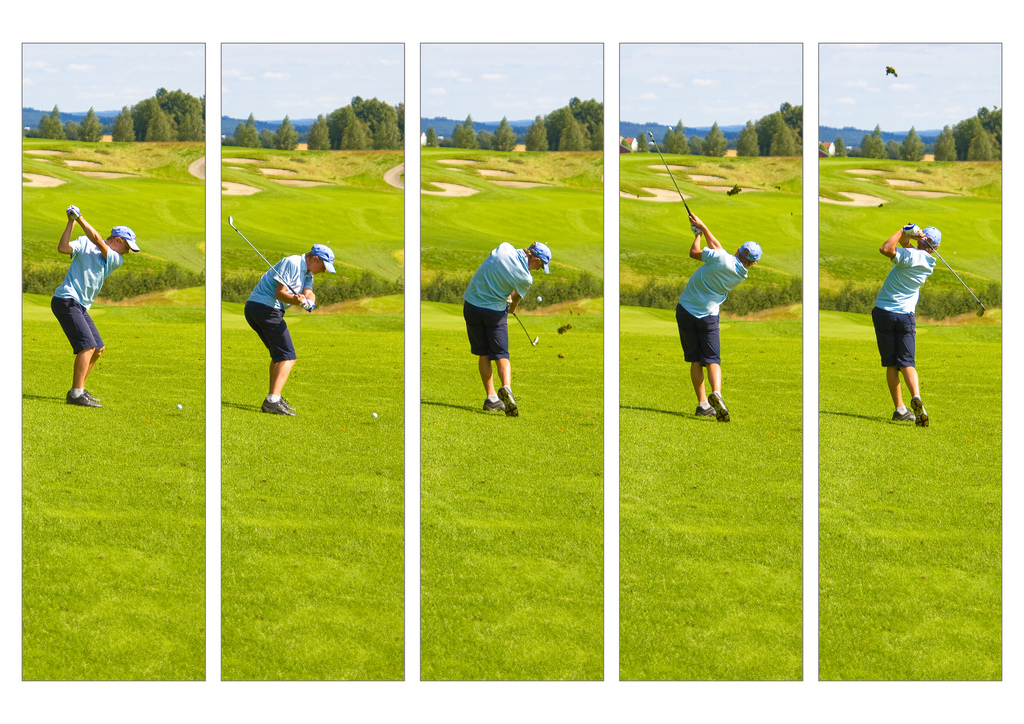
Illustration: Lilrizz / Wikimedia Commons, “Golfer swing,” CC0 1.0. https://commons.wikimedia.org/wiki/File:Golfer_swing.jpg . Commercial reuse permitted. This is a photograph of a normal golf swing, not a demonstration of the lead-arm drill. https://creativecommons.org/publicdomain/zero/1.0/
Read more on this topic