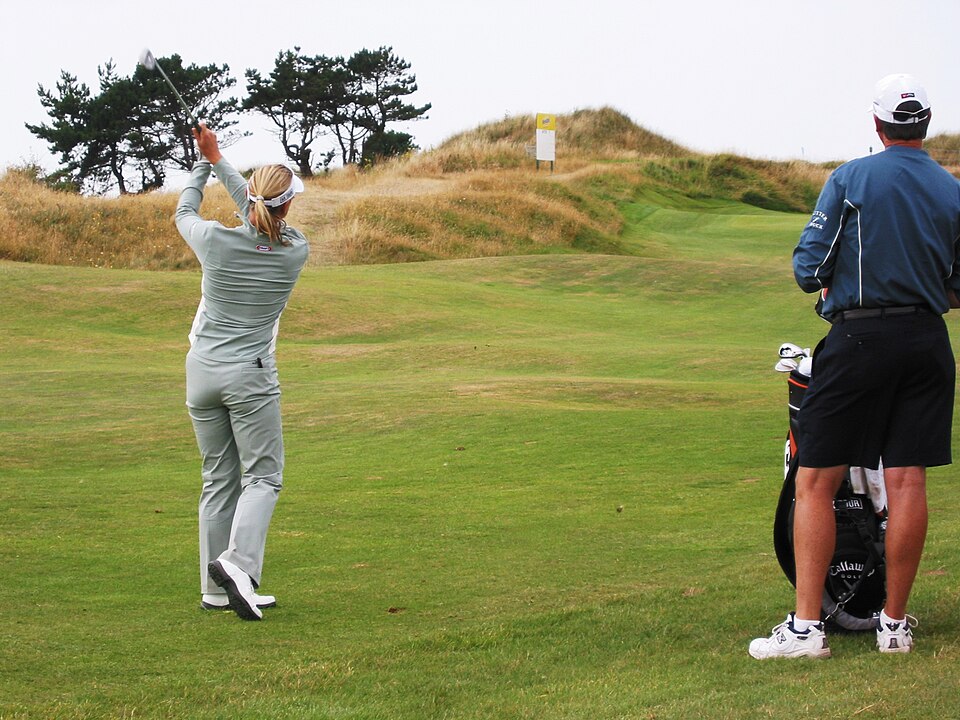
One movement system, not two unrelated swings
Golf Digest Online published the second instalment of its Florida-filmed Hideki Matsuyama short-game series on 3 November 2026. Matsuyama's central point is that a chip around the green belongs to the same movement system as a full shot. When he changes face delivery, body motion or pressure distribution in the longer swing, he may have to fine-tune the short game too. Sometimes the process works in reverse: a feel developed in the shorter motion helps reorganise the longer swing.
This is not a claim that every golfer needs one fixed chipping setup. Matsuyama describes a method that evolves with his own swing and the conditions under the ball.
Three address details worth understanding
Ball position. Matsuyama pictures the ball roughly in line with his left heel. He also makes clear that this is a personal reference point, not a permanent measurement: it can shift when the swing changes. For a right-handed player, that is relatively forward for a chip, so copying it for every shot would miss the point.
Lead foot. He turns his left toe slightly outward, which he feels makes it easier for the club to move through the turf. The adjustment is small. It should not be taken as an instruction to force the knee or hips into an uncomfortable position.
Hands and clubface. To an observer, his hands can look forward of the ball and the clubface slightly open. He describes the setup as square from his own perspective. The distinction matters: a still image does not reveal what the player feels, how the face arrives at impact, or why the shot works.
Pressure and wedge choice are situational
For many ordinary short shots, Matsuyama describes a baseline of around 60% of pressure on the left foot and 40% on the right. An awkward lie, including grass growing against the club's path, can lead him to favour the lead foot more—sometimes about 70% or even 80%. These are reported preferences, not universal pressure targets.
He also treats his 56° and 60° wedges as variations of essentially the same motion. Club choice, face presentation and the desired landing window depend on the shot and the feel he wants. The important result is predictable strike and flight, not how closely an amateur's address resembles a professional's photograph.
A simple practice comparison
The following is an editorial practice adaptation, not a drill Matsuyama claims to have prescribed or tested on readers.
- On a suitable short-game area, select one wedge and a small landing zone. Hit five unhurried shots with your normal setup. Note first contact with the ground, starting direction and where the ball lands.
- Slightly flare the lead-foot toe while keeping other variables stable. Hit another five balls. Compare the consistency of contact and dispersion, rather than judging one perfect shot.
- Alternate a short chip and a modestly longer pitch. Ask whether the face moves through impact with a similar natural feeling. If the adjustment makes contact worse, revert.
- Only then compare a second wedge loft. Separate carry, launch and roll when assessing the result. Do not force Matsuyama's ball position or weight distribution into a swing that does not suit them.
For left-handed golfers, reverse the left/right references. Practice in an appropriate area and consider professional coaching for persistent contact issues. The lesson's transferable principle is continuity between the short and full swing, rather than imitation of one static pose.