Balance in the Golf Swing: What a Review of 42 Studies Really Tells Us
A systematic review of 42 studies links some foot-pressure measures to clubhead speed, but no single number defines a good swing. Learn the distinction between centre of mass and centre of pressure, plus a careful practice routine.

Good balance does not mean standing still
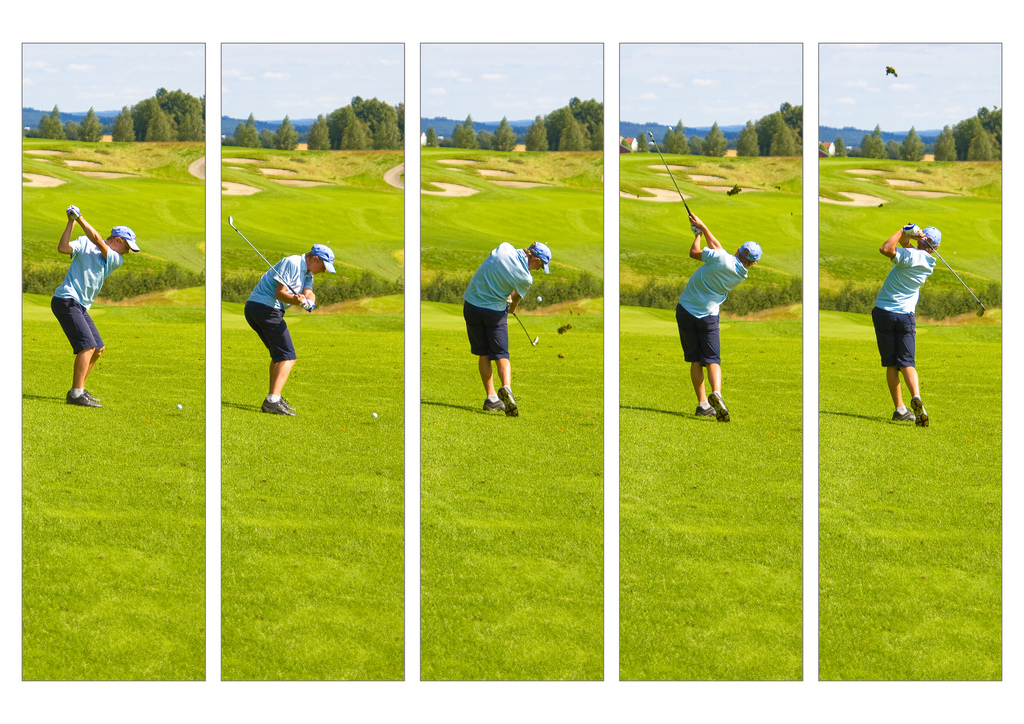
A golf swing involves rotation, changing support under the feet and accelerating the club. That makes “keep perfectly still” a poor universal instruction. A systematic review by Helen Norris, Cleveland T. Barnett, Paul J. Felton and Charlotte Apps, included in the October 2026 issue of the International Journal of Sports Science & Coaching, examined 42 studies of dynamic balance during golf strokes. The paper first appeared online on 21 July 2026; October is the journal issue date, not a newly conducted experiment.
The researchers asked two distinct questions: how can dynamic balance be measured, and how well do those measures relate to golf performance? Distinguishing skilled from less-skilled players is not the same as proving that deliberately changing a measurement will improve someone's shots.
Centre of mass versus centre of pressure
The centre of mass (CoM) represents the distribution of body mass and can be estimated from motion-capture measurements. The centre of pressure (CoP) is the resultant point of pressure against the supporting surface, typically estimated using force plates or foot-pressure sensors.
CoP can move considerably while a golfer remains in functional control. Movement is not necessarily a balance error. Likewise, a small CoP excursion does not, by itself, demonstrate a technically sound or accurate swing.
Of the 42 studies, six concentrated on centre-of-mass measurements, 27 used force-plate or plantar-pressure measures, and nine examined CoM and CoP together. Considering both may give a fuller account of dynamic balance. Yet the relationship between those combined measurements and performance is still unclear.
What the evidence actually found
Several side-to-side CoP measures during the full swing — displacement, range and velocity — correlated with clubhead speed in studies included in the review. Correlation is not an instruction to force pressure toward a particular foot, nor does it establish ideal timing or a one-size-fits-all pressure trace.
Researchers also found that the distance and inclination between CoM and CoP may help distinguish skill levels. Crucially, the review did not identify an established association between those combined measures and performance outcomes. A pressure graph should not be marketed as a universal blueprint for an effective swing.
Applying the findings without over-correcting
A useful practice principle is to assess contact, ball flight and controlled movement together. Notice whether you can finish in a balanced position, where the ball starts, and how consistently you strike a series of shots. Feeling extra pressure under one foot is a subjective cue, not a numerical measurement; a smartphone video cannot directly measure CoP.
Avoid locking the knees, freezing hip rotation or keeping both feet unnaturally planted simply to appear stable. If you have access to pressure plates, evaluate the results with a qualified coach who understands your club choice, physical ability and shot intention.
An optional 12-shot GOLFTWITT observation routine
This is an editorial self-observation exercise, not a training protocol shown by the review to improve performance.
- Warm up on a safe practice area. Choose a comfortable iron and a clearly defined target. There is no need to swing at maximum speed.
- Hit four normal shots. After each, record contact quality, initial direction and whether your finish felt controlled.
- Before each of the next four shots, make one gentle rehearsal swing without a ball. Allow your normal movement instead of forcing pressure into a foot; then hit the ball as usual.
- Hit the final four shots without the rehearsal. Compare the three groups and look for repeatable patterns rather than a single perfect strike.
No change in performance is a legitimate observation. This routine does not promise extra distance, improved accuracy or injury prevention. Repeating the comparison on another day is more informative than interpreting one successful ball. Stop if you experience pain, dizziness or instability.
The limits of the conclusion
The paper synthesised existing research using different measurements and methods; it was not a controlled trial of a new balance-training programme. Associations do not demonstrate causation, and the review does not establish that a particular balance drill increases clubhead speed, reduces injuries or lowers handicap for everyone.
The practical lesson is modest but valuable: good golf balance is controlled movement, not the absence of movement. Track your own outcomes and make technical changes with coaching rather than chasing a supposedly perfect pressure trace.
Research source: Norris H., Barnett C. T., Felton P. J., Apps C. (2026), A systematic review of dynamic balance within golf, International Journal of Sports Science & Coaching, 21(5), 3533–3553. Online first: 21 July 2026; issue: October 2026. DOI: https://doi.org/10.1177/17479541261468314.
Read more on this topic