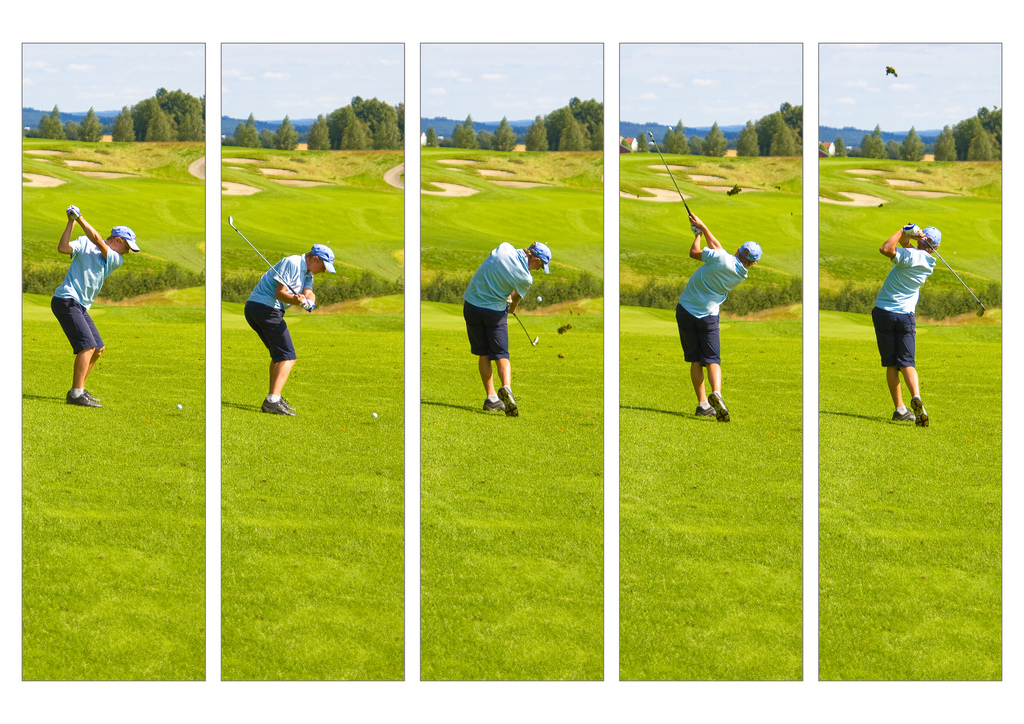
Find your swing's low point: a feedback drill for cleaner iron contact
A training-range clip of Eugenio Chacarra highlights low-point feedback. Learn what the term means and try a careful 12-ball iron-contact check without treating an aid as a proven shortcut.

Why the bottom of the swing matters
In a story published on 20 October 2026, Golf Monthly described a DP World Tour range video showing Eugenio Chacarra practicing with a bright-orange Strike Wedge positioned behind his clubhead. The training aid, designed by PGA professionals Chris Rose and Toby Williams, provides a visible reference: swing towards the ball without striking the object behind it. The educational takeaway is immediate feedback about where the club travels, not a requirement to buy a particular product.
There is an important distinction between observation and causation. The footage shows Chacarra using the aid. It does not establish that the product caused his improved statistics, tournament victories or any particular distance gain. The Golf Monthly report is not a controlled study.
What “low point” actually means
Low point is the lowest position of the clubhead's swing arc. TrackMan describes its location relative to impact. A low point after impact generally means the clubhead is still travelling down when it meets the ball; a low point before impact indicates an upward strike. Low point does not mean how low a player's head or hips move.
For a typical iron shot from grass, a useful observation is whether the club reaches the ball before the turf behind it. A turf mark may start on the target side of the original ball position. Yet taking a divot is not compulsory: club selection, turf conditions and individual delivery vary. A teed-up driver can demand a different impact pattern, so an iron drill should not be imposed on every club.
Look for a pattern, not one poor shot
A fat shot occurs when the club contacts the ground too early, before the ball. It may feel heavy and lose distance. But one short shot does not prove a low-point fault; off-centre face contact and other factors can change the result. Record several swings under similar conditions.
On an authorised grass practice area, you can note the ball's original position and observe where the first turf contact begins. A practice mat does not show a normal divot; a coach, appropriate launch-monitor information or a face-impact marker may provide other feedback. Do not force a deep divot merely to produce evidence.
GOLFTWITT's editorial 12-ball check
This is an original observation drill, not a scientifically validated intervention or Chacarra's personal practice plan.
- Choose a familiar short or mid iron, consistent balls and a safe practice area. Start with relaxed rehearsal swings.
- Hit four baseline shots at approximately three-quarter effort. Note whether the club appears to strike the ground before the ball, the quality of contact and the initial ball direction.
- For four more shots, use a permitted visual reference. On a suitable grass range, a short line aligned with the ball's position can help you see where turf contact begins. Never place a hard obstacle within the club's possible path.
- Hit the final four shots without the reference. Compare early-ground-contact frequency, contact quality and dispersion. Avoid increasing speed just to make the numbers look better.
A record might say “two early ground contacts in the first four, one in the middle four, two in the last four.” That describes a session; it does not prove lasting improvement. If the exercise appears useful, repeat it another day. If it does not, ask a qualified coach to assess ball position, setup and movement sequencing rather than chasing a single universal swing fix.
Important limits
Do not try to solve every low-point issue by freezing the head, making a sudden weight shift or forcing the hips into a preset shape. Keep solid equipment out of the hitting zone, follow your facility's safety rules, and stop if a movement hurts. A bunker, heavy rough or artificial mat calls for a different interpretation than a normal fairway lie.
The practical lesson: Chacarra's range setup highlights how clear feedback can focus a practice session. Track where the club interacts with the ground, compare repeated shots and treat any perceived change as something to test—not as a guaranteed result.
Sources and editorial note: Golf Monthly, Matt Cradock, 20 October 2026; TrackMan, “What is Low Point?”, 30 May 2024. The 12-ball exercise is a GOLFTWITT editorial suggestion, not a published evaluation of the Strike Wedge.
Read more on this topic