Operating figures, not just a manufacturer’s promise
Germany’s Golfpark Weiherhof, in Wadern, Saarland, has provided a concrete example of how golf-course maintenance can change when mowing becomes increasingly electric. An operational case study published by Golf Sustainable on 22 October 2026 reports that annual diesel consumption fell from 18,180 litres in 2024 to 8,683 litres in 2025 after autonomous electric mowers took over substantial areas of the 27-hole facility. That is 9,497 fewer litres, approximately 52.2%.
The key qualification: this measures a reduction in diesel fuel use and the emissions attributed to burning that fuel. It does not establish a 52% reduction in all of the club’s greenhouse-gas emissions.
How the fleet works
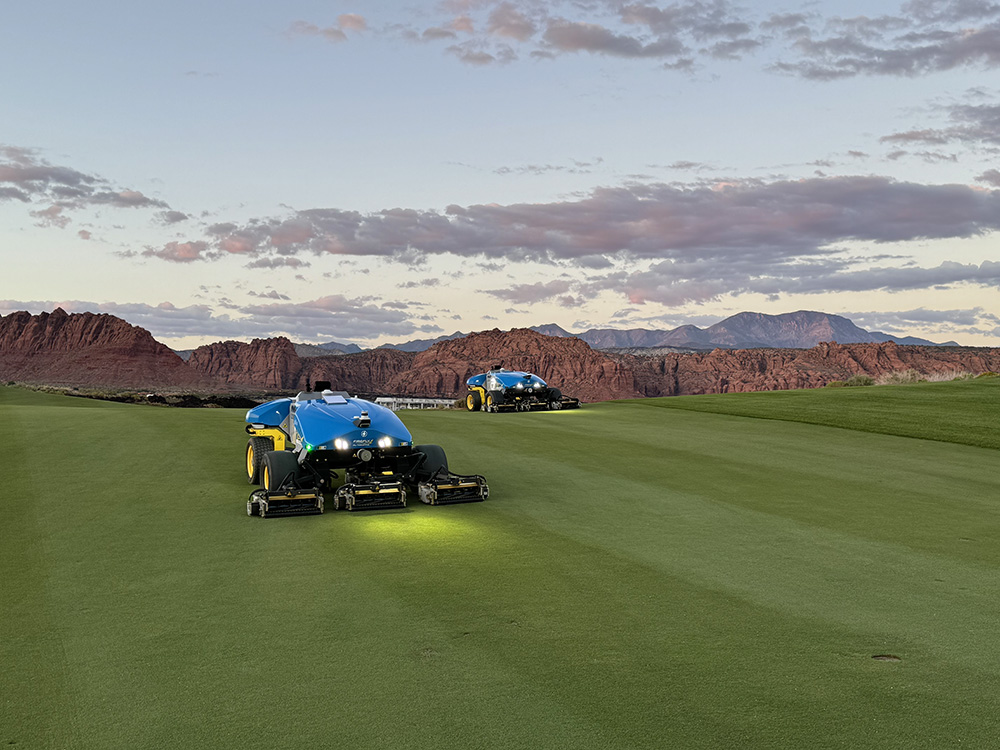
According to the report, 25 robotic mowers cover 33.13 hectares: seven Husqvarna CEORA machines, seven Automower 535s, and eleven Automower 580Ls. They maintain teeing areas, fairways and semi-rough. Diesel mowers remain in use on the greens. The transition is therefore substantial but not a complete switch to electric machinery.
Weiherhof’s official website independently confirms that the Saarland property has 27 holes arranged in three nine-hole loops. Its fleet sizes and fuel figures come from the operational reporting rather than from a full public sustainability audit.
What the carbon numbers do—and do not—show
Using the report’s factor of 2.65 kg of CO₂ per litre of diesel, the earlier annual consumption represents around 48.18 tonnes of CO₂. The newer figure represents 23.01 tonnes. The difference is approximately 25.17 tonnes on this fuel-consumption comparison.
Electric mowers still require electricity. Weiherhof also operates rooftop solar generation, which management says helps charge the machines during daylight hours. Yet the published diesel calculation does not provide a complete accounting of purchased electricity, the manufacture of mowers and batteries, or equipment supply chains. It would be misleading to label the diesel comparison a definitive whole-facility lifecycle emissions result.
What other golf clubs can learn
The case shows a hybrid maintenance approach: robots handle large mowing areas while conventional machinery remains for certain tasks. It offers groundskeepers and club managers a measurable operational reference, not a guaranteed result for every course.
Golf Sustainable also discusses a separate 2025 study in Italy at Montecchia, where an electric-versus-diesel fairway-mowing comparison yielded a calculated 66.2% emissions reduction under that site’s conditions. The Italian percentage should not be applied to Weiherhof: terrain, electricity mix, machinery and research assumptions differ.
For clubs weighing a similar change, an honest comparison must include electricity demand, local carbon intensity, machine servicing, capital expenditure and lifecycle emissions alongside diesel savings. That is the useful lesson behind this German example.
Sources: Golf Sustainable, 22 October 2026; Golf Resort Magazine, 24 October 2026; Golfpark Weiherhof official site.