
Fred Couples’ 5 keys to crisp, accurate iron shots
GOLF.com revisited Fred Couples’ advice from GOLF Magazine’s July 1998 issue. Freedom of motion, a rhythmic transition and a consistent pre-shot routine can help golfers hit approaches closer to the hole.
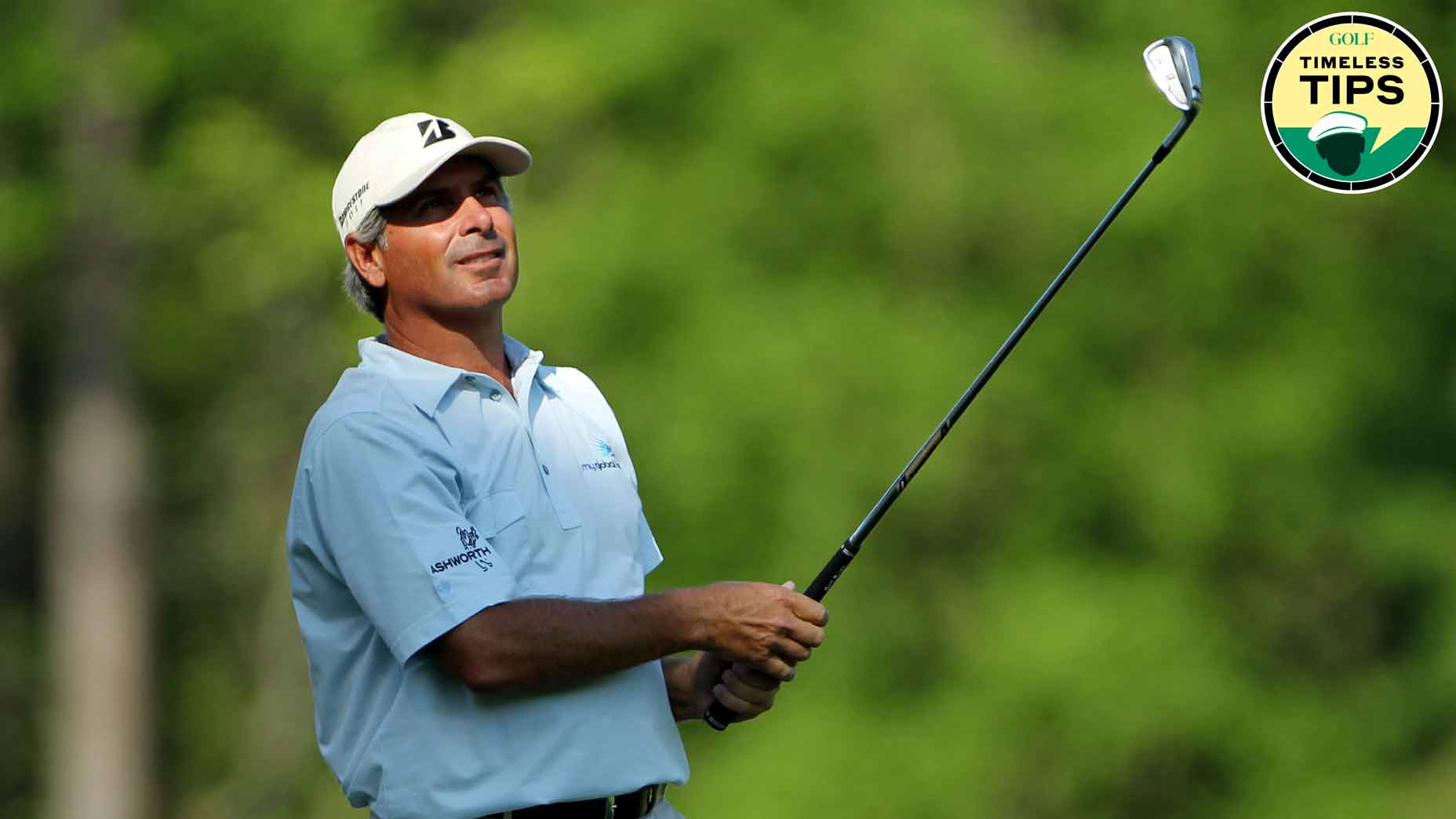
- In its Timeless Tips series, GOLF.com revisited a July 1998 issue of GOLF Magazine, where Fred Couples shared five principles for hitting crisp, accurate iron shots.
- The original article was written by Paul Marchand, Couples’ former University of Houston teammate and coach.
- He won 15 times on the PGA Tour and captured a green jacket at the Masters.
- Take a 6-iron or 7-iron, make a full turn and complete motion, but slow the swing enough for the ball to travel about half its normal distance.
Golf instruction is constantly evolving, but the best advice stands the test of time. In its Timeless Tips series, GOLF.com revisited a July 1998 issue of GOLF Magazine, where Fred Couples shared five principles for hitting crisp, accurate iron shots. The original article was written by Paul Marchand, Couples’ former University of Houston teammate and coach.
Couples’ smooth swing is one of the most recognizable in golf. He won 15 times on the PGA Tour and captured a green jacket at the Masters. His precise iron play from the fairway helped him create frequent birdie opportunities and turn approach shots into scoring chances.
1. Freedom of motion
Couples’ mental and physical approach can be summed up in three words: freedom of motion. He does not force movements or manipulate the club through impact. The paradox of the swing is that the harder players try to control the club at impact, the less control they have over the shot.
Working on positions has its place on the practice range, but the swing must remain free-flowing on the course. When practicing technique, do not worry excessively about where the ball goes. First develop a feel for the movement, then bring freedom back into the swing by trusting the new sensation.
2. Rhythmic transition
Couples has a long swing in which acceleration builds gradually and almost imperceptibly during the downswing. His effortless appearance is the result of a rhythmic transition from the backswing to the downswing.
Most amateurs fall into the trap of hitting from the top in this phase, throwing the club out and away from the body while rushing it back to the ball. Couples does the opposite. As the club reaches the top, he starts the downswing by moving his hips and left leg diagonally to the right of the target line. At the same time, his right elbow drops smoothly toward his side before his torso unwinds powerfully.
These synchronized movements create a shallow clubhead path approaching the ball from slightly inside the stance line. That helps produce a full release, a consistent low point and better control of swing speed.
3. Clubface and body rotation
The ability to consistently return the clubface square at impact is the foundation of accuracy. But players should not try to close the face consciously with their hands or right shoulder.
Through the hitting area, the clubface should rotate along an arc from open to square to closed relative to the target line. If the club swings freely, the rate of clubface rotation will match the rate of body rotation. The better those two movements are synchronized, the more accurate the shot will be.
To check the motion, make a full practice swing and stop the club waist-high on the backswing and waist-high on the follow-through. In both positions, the toe of the club should point upward, while the shaft and clubhead should be in front of the body and parallel to the target line. This indicates that the clubface is squaring through impact in sync with the body rotation.
4. Develop feel
Players need to understand the mechanics of their swing, but they also need to know what a correct motion feels like. That is what is commonly called muscle memory.
On the course, you need confidence that you can reproduce the sensation of a good swing. That frees the mind and allows the body to move naturally. Couples relies heavily on that feeling, and recreational players should do the same.
One of the best ways to develop feel is to hit shots of different distances with the same club. Take a 6-iron or 7-iron, make a full turn and complete motion, but slow the swing enough for the ball to travel about half its normal distance. Then gradually vary the distance by changing the speed of your body rotation.
Couples also likes to test this feeling by hitting a driver or 3-wood on a short par 3. For example, he hits a 3-wood from 147 yards—about half the club’s potential distance. The only adjustment is a slower body rotation while keeping the club moving in sync.
Learning to vary swing speed improves feel for the club and confidence in repeating the motion without conscious thought. That leads to more consistent contact.
5. A consistent pre-shot routine
Every professional commits to a pre-shot routine. Amateurs often play without one, even though it is one of the easiest professional habits to copy.
Once over the ball, a routine helps the mind and body swing from memory instead of cycling through technical instructions. Done correctly, it leaves the player focused on the target image and on confidently anticipating the feel of the shot.
Couples keeps technical thoughts on the practice range. When working on a specific element, he does not care where the ball goes and concentrates only on the mechanics until they become part of his feel. After that, he returns his focus to the target with the help of his routine and lets go of the swing thought. On the range, Couples also rehearses key shots he may need on the course while using his full pre-shot sequence.
Freedom, rhythm and feel can make a swing more accurate. Once these principles become part of a player’s instincts, they can help produce more approaches close to the hole and create more birdie opportunities.
Read more on this topic


